Our Short List of 3

- Best for: Owners with industry-standard bed rails who want the quietest 20,000 lb tow in this group.
- Gross trailer weight: 20,000 lb
- Vertical load: 5,000 lb
- Fully articulating head allows front to back and side to side pivoting
- Cam action latching handle for easy release, even when parked on unlevel sites
- Best for: Long-bed owners on a budget towing a mid-size fifth wheel under 16,000 lb.
- Gross trailer weight: 16,000 lb
- Item weight: 95.1 lb
- Pivots on dual axes for 10 degrees of lateral movement
- Automatically locks for easy, secure coupling
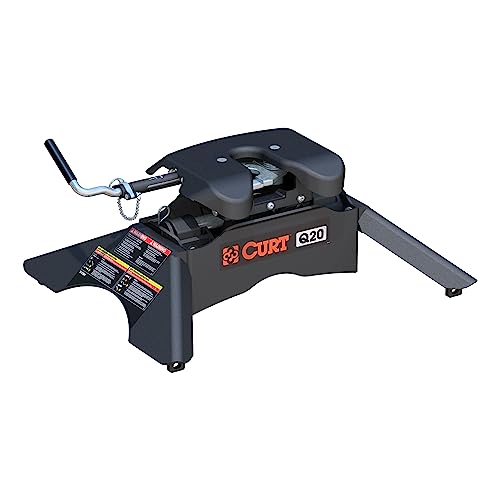
- Best for: Drivers who want visible coupling confirmation and a quiet 20,000 lb tow on standard rails.
- Gross trailer weight: 20,000 lb
- Vertical load: 5,000 lb
- Tested to SAE J2638 specifications
- Spherical axial bearing allows the head to tilt in any direction
All 5 Picks at a Glance
| Product | Specs | Action |
|---|---|---|
| B&W Companion Fifth Wheel Hitch RVK3500 |
| Check price on Amazon |
| CURT E16 5th Wheel Hitch 16115 |
| Check price on Amazon |
| CURT Q20 5th Wheel Hitch 16130 |
| Check price on Amazon |
 CURT A16 5th Wheel Hitch 16120 |
| Check price on Amazon |
 CURT A25 5th Wheel Hitch for Select HD Puck Systems |
| Check price on Amazon |
Key takeaways
- Find the best fifth wheel for pickup truck towing before you buy: B&W Companion, CURT E16, Q20, A16 and A25 compared on capacity and fitment.
A fifth wheel hitch is the one part of a towing setup that decides whether a heavy trailer follows the truck calmly or fights it on every bump and turn. The wrong choice shows up as chucking over bridge joints, a trailer nose that drifts toward the cab on a tight turn, or a hitch that cannot legally carry the trailer once the tanks are full and the bed is loaded. The right choice disappears into the drive, and that is exactly what this guide is for.
This article is for pickup owners who tow a fifth wheel RV or a heavy gooseneck-style trailer with a kingpin, from weekend campers with a mid-size fifth wheel to full-timers pulling a 25,000 lb rig. Every product below was chosen from names and specs on Amazon product pages, with capacity, mount type and fitment stated from the listing so the hitch can be matched to the truck before anything is ordered.
Quick Picks
As an Amazon Associate we earn from qualifying purchases
| Product | Best for | Key spec from title |
|---|---|---|
| B&W Companion RVK3500 | Quiet towing on standard rails | 20,000 lb GTW |
| CURT E16 16115 | Budget rail-mount towing | 16,000 lb GTW |
| CURT Q20 16130 | Clear coupling feedback | 20,000 lb GTW |
| CURT A16 16120 | Shock-damped 16K towing | 16,000 lb GTW |
| CURT A25 | Heavy 25K GM puck trucks | 25,000 lb GTW |
How to Choose
Match the rating to the loaded trailer
A hitch rating means nothing next to an empty trailer weight. Gross trailer weight is the trailer fully loaded, with water, propane, gear and cargo, and the vertical load is the pin weight pressing down on the hitch. A 16,000 lb hitch suits most mid-size fifth wheels, while a trailer over 20,000 lb needs a 25,000 lb hitch with a 6,250 lb vertical rating. Check the trailer placard for its GVWR and the truck door sticker for payload, then pick a hitch whose numbers clear both with room to spare. Capacity is always limited to the lowest-rated towing component in the chain.
Puck system or industry-standard rails
The mount decides which hitches even fit. Trucks ordered with the factory fifth wheel and gooseneck prep package have four pucks and a center hole in the bed, and they take puck-mount hitches built for that exact brand and model year range, such as the CURT A25 for select Silverado and Sierra HD trucks. A truck without pucks takes industry-standard rails, two steel rails bolted across the bed to frame brackets underneath, and any rail-mount hitch fits them. Measure the bed and confirm the prep package before ordering, because a puck hitch has nothing to drop into on a bare bed.
Short bed or long bed
Bed length decides whether a slider is needed. A long bed of eight feet gives the trailer nose room to swing, so a fixed hitch works. A short bed of six feet four inches to six feet nine inches puts the trailer front cap close to the cab corner in a sharp turn or while backing into a site, and a slider that moves the hitch rearward, or a pin box built for short beds, keeps the two apart. Fixed hitches are simpler and lighter, but on a short bed the slider is cheap insurance against cab damage.
Jaw design, articulation and noise
Two hitches with the same rating can tow very differently. Interlocking dual jaws wrap the kingpin more completely than a single sliding bar, and a fully articulating head that pivots front to back and side to side keeps the trailer and truck moving independently over uneven ground. Poly-torsion inserts in the yoke and polyurethane bushings soak up shock loads before they reach the cab, which is what makes one hitch quiet and another one chuck and rattle. A coupling indicator that shows coupled, uncoupled or ready to tow removes guesswork at hookup, and a handle that locks adds security on the road.
The 5 Best Options
B&W Companion Fifth Wheel Hitch RVK3500
- Best for: Owners with industry-standard bed rails who want the quietest 20,000 lb tow in this group.
- Gross trailer weight: 20,000 lb
- Vertical load: 5,000 lb
- Fully articulating head allows front to back and side to side pivoting
- Cam action latching handle for easy release, even when parked on unlevel sites
Owners with industry-standard bed rails who want the quietest 20,000 lb tow in this group.
The hitch is heavy and two-piece, so plan for help moving it in and out of the bed, and confirm rail spacing before ordering.
The Companion RVK3500 is the rail-mount hitch for owners who want a quiet, settled tow without giving up capacity, and its fully articulating head is the reason it earns that reputation. The head pivots front to back and side to side, so the trailer follows uneven ground without levering the truck, and the polyurethane bushings take the edge off small shocks that otherwise arrive in the cab as rattles. The cam action latching handle releases easily even when the rig is parked on unlevel ground, which matters at campgrounds that are never flat. At 20,000 lb gross trailer weight and 5,000 lb vertical load it covers most fifth wheel RVs.
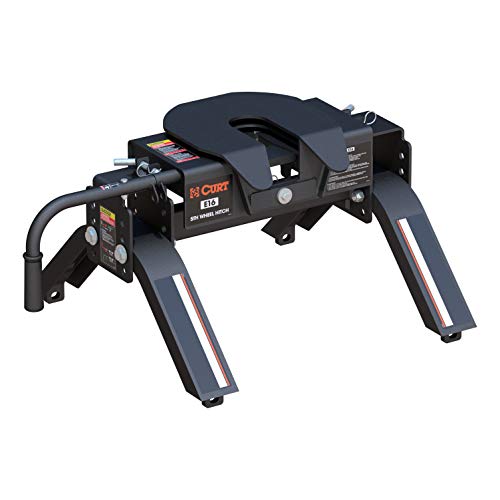
CURT E16 5th Wheel Hitch 16115
- Best for: Long-bed owners on a budget towing a mid-size fifth wheel under 16,000 lb.
- Gross trailer weight: 16,000 lb
- Item weight: 95.1 lb
- Pivots on dual axes for 10 degrees of lateral movement
- Automatically locks for easy, secure coupling
Long-bed owners on a budget towing a mid-size fifth wheel under 16,000 lb.
Base rails and brackets are sold separately, and the 16,000 lb rating is a hard ceiling once the trailer is loaded.
The CURT E16 is the straightforward budget pick for long-bed trucks pulling a fifth wheel under 16,000 lb, and it keeps the feature list honest for the class. It pivots on dual axes for ten degrees of lateral movement, locks automatically when the kingpin seats, and runs on a single handle, so coupling is a short, simple routine rather than a two-person job. The anti-rattle skid plate helps keep noise down, and four height adjustment positions let the head sit level with the trailer. It arrives with a set of standard fifth wheel legs ready to mount into the truck bed.
CURT Q20 5th Wheel Hitch 16130
- Best for: Drivers who want visible coupling confirmation and a quiet 20,000 lb tow on standard rails.
- Gross trailer weight: 20,000 lb
- Vertical load: 5,000 lb
- Tested to SAE J2638 specifications
- Spherical axial bearing allows the head to tilt in any direction
Drivers who want visible coupling confirmation and a quiet 20,000 lb tow on standard rails.
It is not compatible with articulating or turret-style pin boxes, such as Rota-Flex and Sidewinder, so check the pin box type first.
The CURT Q20 is built around one idea, that the driver should always know the coupling state without climbing into the bed to check. Its three-position indicator shows coupled, uncoupled or ready to tow from the side of the truck, and the spherical axial bearing lets the head tilt in any direction the terrain demands. The single short-throw handle is lockable for security, and the jaws wrap fully around the kingpin for a quiet ride. It is tested to SAE J2638 and rated for 20,000 lb gross trailer weight and 5,000 lb vertical load, which covers the bulk of fifth wheel RVs sold in the United States.
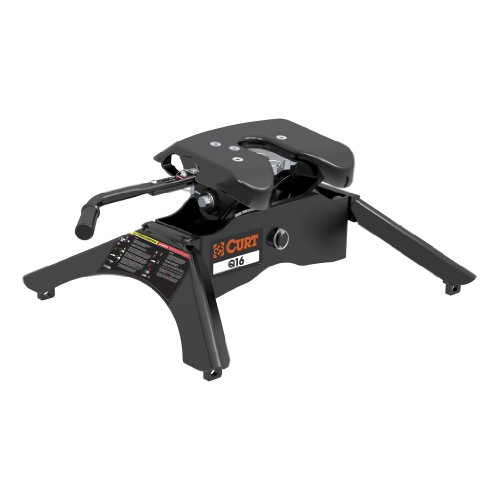
CURT A16 5th Wheel Hitch 16120
- Best for: Long-bed owners who want the quietest 16,000 lb tow and a clear coupling indicator.
- Gross trailer weight: 16,000 lb
- Vertical load: 4,000 lb
- Tested to SAE J2638
- Cast yoke with poly-torsion inserts to suppress shock loads and reduce noise
Long-bed owners who want the quietest 16,000 lb tow and a clear coupling indicator.
Base rails and brackets are sold separately, the 4,000 lb vertical load is the real ceiling, and it ships freight only.
The CURT A16 takes a different engineering path from the E16 and Q20, using a cast yoke with poly-torsion inserts that absorb shock loads before they travel into the cab. That is what makes it the quiet-riding mid-priced hitch in this group, and it pairs with interlocking die-cast jaws, an extra-wide head for easier coupling, and a three-position coupling indicator visible from the cab. It is rated for 16,000 lb gross trailer weight and 4,000 lb vertical load, tested to SAE J2638, with a height range of 13 to 17 inches across three adjustment positions. The head weighs 84 lb, and the hitch ships with industry-standard legs and hardware.
CURT A25 5th Wheel Hitch for Select HD Puck Systems
- Best for: Owners of select GM HD long-bed trucks with the factory puck system towing a fifth wheel over 20,000 lb.
- Gross trailer weight: 25,000 lb
- Vertical load: 6,250 lb
- Cast yoke with poly-torsion inserts to suppress shock loads and reduce noise
- Fully articulating torsion head
Owners of select GM HD long-bed trucks with the factory puck system towing a fifth wheel over 20,000 lb.
Fitment is narrow, only select Silverado and Sierra HD models, eight-foot bed, puck system, so confirm the exact truck and model years before ordering.
The CURT A25 is the heavy lifter in this article, built for select Silverado and Sierra 2500 and 3500 HD trucks with an eight-foot bed and the factory puck system. It carries a 25,000 lb gross trailer weight rating with a 6,250 lb vertical rating, which covers the largest fifth wheels a one-ton truck can legally pull. The cast yoke uses poly-torsion inserts to suppress shock loads and cut noise, the torsion head articulates fully, and the lockable handle resets itself to the ready-to-couple position after uncoupling, so the next hookup starts clean. Quarter-turn anchoring drops the legs into the factory pucks without rails through the bed.
Which One Fits Your Situation
A long-bed truck and a mid-size fifth wheel
Pick the CURT E16 if the loaded trailer stays under 16,000 lb and the budget matters, or the CURT A16 if a quieter ride and a coupling indicator are worth the step up. Both mount to industry-standard rails, both carry a limited lifetime warranty, and both are fixed hitches that suit an eight-foot bed. The A16 adds poly-torsion inserts and interlocking jaws, while the E16 keeps the weight down at 95.1 lb.
A heavy fifth wheel on standard rails
Pick the B&W Companion RVK3500 or the CURT Q20, both rated for 20,000 lb gross trailer weight and 5,000 lb vertical load on industry-standard rails. Choose the Companion for its fully articulating head, polyurethane bushings and Made in America build, or the Q20 for its three-position coupling indicator and spherical axial bearing. Either one covers the bulk of full-size fifth wheel RVs.
A GM HD truck with the factory puck system
Pick the CURT A25, because it is the only hitch in this article built for the select Silverado and Sierra HD puck system at a 25,000 lb rating. It drops into the factory pucks with quarter-turn anchors, keeps the bed floor flat when removed, and handles trailers the 20,000 lb hitches cannot legally carry. Confirm the truck is a select 2500 or 3500 HD with an eight-foot bed before ordering.
A short-bed truck
None of the fixed hitches in this article is the safe default for a short bed, because the trailer front cap can meet the cab corner in a sharp turn. A slider hitch, or a pin box built for short beds, is the right answer there, and the B&W Companion OEM Slider and the CURT A25 Slider exist for that job. If the truck has rails and the trailer is light, measure cab clearance at full lock.
Common Mistakes
- Buying a hitch rated for the empty trailer weight instead of the fully loaded gross trailer weight.
- Ordering a puck-mount hitch for a truck bed that has no factory prep package to drop it into.
- Fitting a fixed hitch on a short bed without checking cab clearance at full steering lock.
- Forgetting that base rails and brackets are sold separately on most rail-mount hitches in this article.
- Pairing a hitch with an articulating or turret-style pin box that the listing says it is not compatible with.
Frequently Asked Questions
What size fifth wheel hitch do I need for my pickup truck?
Match the hitch to the loaded trailer, not the empty one. A mid-size fifth wheel under 16,000 lb suits a 16,000 lb hitch, most full-size fifth wheels need a 20,000 lb hitch with a 5,000 lb vertical rating, and trailers over 20,000 lb need a 25,000 lb hitch. Also check the truck payload on the door sticker, since pin weight counts against it.
Do I need a slider hitch for a short bed truck?
Usually yes. A short bed of six feet four inches to six feet nine inches leaves little room between the trailer front cap and the cab corner, and a slider moves the hitch rearward for tight turns and backing into sites. Long beds of eight feet do not need one. Measure cab clearance at full steering lock before deciding.
What is the difference between a puck system and rail mounts?
A factory puck system is four mounting points and a center hole built into the bed by the truck maker, and puck hitches drop straight into it with no rails. Industry-standard rails are two steel rails bolted across the bed to frame brackets underneath, and any rail-mount hitch fits them. Puck hitches only fit the brand and model years they were built for, while rails are universal.
Can I install a fifth wheel hitch myself?
Most rail-mount hitches in this article are bolt-on jobs for a confident home mechanic, but the work includes drilling the bed, fitting frame brackets underneath and torquing hardware to spec. Puck hitches are simpler since they drop into factory mounts. Given the weight of these hitches and the safety stakes, many owners have a shop do the first install and then handle removal and refitting themselves.