Our Short List of 3

- Best for: Riders who want one quiet, stable helmet for track days and long road rides alike.
- Shell: AIM+ multi-composite, fiberglass and organic fiber
- Weight: 3.6 pounds as listed
- Certifications: Snell M2020D, DOT, FMVSS 218
- Shield: CWR-F2 with Pinlock EVO lens included

- Best for: Riders who feel helmet weight on long days and want the widest view of the road.
- Shell: Carbon-aramid fiber composite
- Weight: 1,255 g in first shell size
- Certifications: ECE 22.06, DOT FMVSS 218
- Field of view: 190 degrees horizontal

- Best for: Track-day riders who want a carbon shell and a shield that adapts to changing light.
- Shell: 3K carbon fiber
- Liner: Flex three-layer impact liner
- Shield: ProTint photochromic, Panovision Class 1 optics
- Cheek pads: Magnefusion magnetic, removable
All 5 Picks at a Glance
| Product | Specs | Action |
|---|---|---|
| Shoei RF-1400 |
| Check price on Amazon |
| AGV K6 S |
| Check price on Amazon |
| Bell Race Star Flex DLX |
| Check price on Amazon |
 Arai Corsair-X |
| Check price on Amazon |
 Shoei RF-SR |
| Check price on Amazon |
Key takeaways
- Find the best motorcycle race helmet for track days: 5 Snell and ECE certified full-face lids compared on shell weight, shield optics and ventilation.
A race helmet is not a street helmet with louder graphics. On a track day you spend long stints folded into a tuck at sustained speed, where a heavy shell drags on your neck, a narrow eye port hides the next apex, and a shield that fogs on the out lap costs you confidence before the first braking zone. Certification matters too, because most track-day organizers in the United States ask for a Snell-rated lid, and a helmet that only carries a basic DOT sticker can leave you watching from the pit wall.
This article is for track-day riders, sportbike owners, and club racers who want one helmet that works for lapping days and still behaves on the road home. The five helmets below were chosen from names and specifications published on their Amazon product pages, with weight, shell construction, certification, and shield systems compared side by side so you can match a lid to your head shape and your riding.
Quick Picks
As an Amazon Associate we earn from qualifying purchases
| Product | Best for | Key spec from title |
|---|---|---|
| Shoei RF-1400 | All-round track days with quiet aerodynamics | AIM+ shell, Snell M2020D, 3.6 lb |
| AGV K6 S | The lightest lid here for long sessions | Carbon-aramid shell, 1,255 g, ECE 22.06 |
| Bell Race Star Flex DLX | Photochromic shield from dawn to dusk | 3K carbon shell, ProTint shield, ECE 22.06 |
| Arai Corsair-X | Riders who trust Arai fit and VAS shield | PB SNC2 shell, Snell M2025, VAS shield |
| Shoei RF-SR | Snell protection at the lowest step into Shoei | AIM shell, Snell M2020D, Pinlock EVO shield |
How to Choose
Certification That Matches Your Track
Before you compare shells, check what your track-day organizer accepts. Snell M2020 and the newer Snell M2025 are the usual gatekeepers at United States track days, while ECE 22.06 is the current European standard and a strong mark in its own right. A DOT sticker alone is a legal minimum, not a racing credential, and it will not satisfy every organizer. Every helmet in this article carries Snell or ECE 22.06 certification, so none of them fails the paperwork test. If you ride with several organizations, pick a lid that carries both Snell and ECE stamps and you stop thinking about the rulebook entirely.
Shell Weight and Balance
A few hundred grams sounds trivial in the store and feels like nothing on a short ride, then you spend six hours in the saddle and every head check carries that extra mass. The lightest lid here, the AGV K6 S, weighs about 1,255 grams in its first shell size, while a composite Shoei sits closer to 1,650 grams. Carbon and carbon-aramid shells run roughly 20 to 30 percent lighter than polycarbonate at the same protection level. Weight alone is not the whole story, though, because balance matters as much as the number on the scale. A well-balanced shell with the mass centered low feels lighter than a lighter shell that pulls forward in a tuck.
Shield Optics and Ventilation
At track speed your shield is your windscreen, so optics decide how early you spot a braking marker. Look for a wide eye port, a Pinlock-ready shield with an anti-fog insert in the box, and a latch you can work with gloves on. The Bell in this article goes further with a photochromic shield that tints in sun and clears at dusk, which removes one visor swap from a full day. Ventilation has to work while you are folded forward, not just sitting upright. Front intakes and rear extractors that pull air across the crown keep the shield clear and your head cool through a twenty-minute session.
Fit Shape and Sizing
No certification or shell material saves a helmet that does not fit your head. Most premium lids in this article use an intermediate oval interior, which suits the majority of riders, while Arai offers a rounder shape that some heads find far more comfortable. Measure your head circumference, check the maker size chart, and remember that cheek pads break in slightly over the first weeks. A new race helmet should feel snug enough that the skin on your forehead moves when you twist the shell, with no pressure point that throbs after ten minutes. If you sit between sizes, try the smaller one first.
The 5 Best Options
Shoei RF-1400
- Best for: Riders who want one quiet, stable helmet for track days and long road rides alike.
- Shell: AIM+ multi-composite, fiberglass and organic fiber
- Weight: 3.6 pounds as listed
- Certifications: Snell M2020D, DOT, FMVSS 218
- Shield: CWR-F2 with Pinlock EVO lens included
Riders who want one quiet, stable helmet for track days and long road rides alike.
No drop-down sun visor, so carry sunglasses or a tinted shield for low sun.
The RF-1400 is the benchmark full-face that other helmets in this class get measured against, and it earns that spot with refinement rather than flash. Its hand-laid AIM+ shell blends fiberglass with organic fibers, and the CWR-F2 shield seals tighter than the outgoing model while Vortex Generator shaping breaks up turbulence at the visor edge. At 3.6 pounds it is not the lightest lid here, but its aerodynamics keep it stable and quiet at sustained speed, which is exactly what a long track session demands.
AGV K6 S
- Best for: Riders who feel helmet weight on long days and want the widest view of the road.
- Shell: Carbon-aramid fiber composite
- Weight: 1,255 g in first shell size
- Certifications: ECE 22.06, DOT FMVSS 218
- Field of view: 190 degrees horizontal
Riders who feel helmet weight on long days and want the widest view of the road.
No drop-down sun visor, and the light shell can transmit more wind noise on some bikes.
The K6 S is the featherweight of this group, and you notice the difference the first time you shoulder-check at speed. Its carbon-aramid shell weighs about 1,255 grams in the first shell size, spread across four shell sizes so the proportions stay right from XS to XXL. The 190-degree horizontal field of view is the widest here, which helps you spot riders alongside on corner entry. Five front vents and two rear extractors move air well, and the five-density EPS liner comes from the same Extreme Safety program behind AGV MotoGP helmets.
Bell Race Star Flex DLX
- Best for: Track-day riders who want a carbon shell and a shield that adapts to changing light.
- Shell: 3K carbon fiber
- Liner: Flex three-layer impact liner
- Shield: ProTint photochromic, Panovision Class 1 optics
- Cheek pads: Magnefusion magnetic, removable
Track-day riders who want a carbon shell and a shield that adapts to changing light.
The sport-tuck geometry suits a forward lean and feels less natural upright, and fit runs slightly small.
The Race Star Flex DLX is the most track-focused helmet in this article, built around a 3K carbon fiber shell and a three-layer Flex impact liner that handles low, mid, and high-speed impacts with different foam densities. Its party piece is the ProTint photochromic shield, which tints in bright sun and clears as light fades, so a full lapping day needs no visor swap. Panovision Class 1 optics give a tall, wide view made for a forward lean, and the Magnefusion magnetic cheek pads make liner removal quick between sessions.
Arai Corsair-X
- Best for: Riders who have worn Arai before and want the flagship race fit and finish.
- Shell: PB SNC2 Peripherally Belted e-Complex Laminate Construction
- Shield: VAS variable-axis mechanism, Pinlock-ready
- Certifications: DOT, Snell M2025
- Interior: Intermediate oval fit, Eco-Pure liner
Riders who have worn Arai before and want the flagship race fit and finish.
The highest step up in cost here, and the round-oval shape is unforgiving of narrower heads.
The Corsair-X is Arai flagship race helmet, hand-built around the PB SNC2 shell with a peripheral belt that stiffens the forehead above the eye port. Its VAS shield mechanism uses a variable axis with a moving pivot point, which lets the shell stay smooth and strong around the shield opening. The intermediate oval interior suits a broad spread of head shapes, and the Eco-Pure liner resists odor through long summer sessions. It is the most expensive helmet here, and the one most likely to fit a rider who has never found a Shoei comfortable.
Shoei RF-SR
- Best for: Riders who want Snell certification and Shoei build quality at the most accessible step in.
- Shell: AIM, fiberglass and organic fiber
- Certifications: Snell M2020D, DOT, FMVSS 218
- Shield: Pinlock EVO fog-resistant
- Interior: 3D Custom Interior System, moisture-wicking, removable and washable
Riders who want Snell certification and Shoei build quality at the most accessible step in.
Less refined aerodynamics and sealing than the RF-1400, so it runs louder at sustained speed.
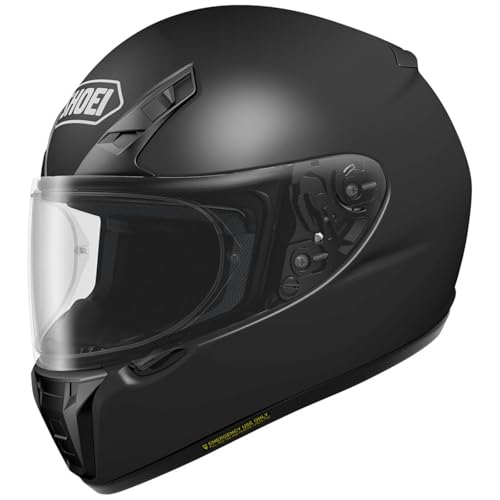
The RF-SR is the way into a Snell-rated Shoei without paying flagship money, and it shares more with the RF-1400 than its lower billing suggests. The AIM shell layers fiberglass with organic fiber, the same family of construction as its bigger sibling, and it carries the same Snell M2020D and DOT approvals. A Pinlock EVO shield comes in the box, the 3D Custom Interior is moisture-wicking, removable, and washable, and the Emergency Quick Release System lets marshals remove the helmet safely after a crash. It gives up some aerodynamic polish to the RF-1400, not protection.
Which One Fits Your Situation
Your First Track Day on a Budget
Pick the Shoei RF-SR. It carries the same Snell M2020D approval the organizers ask for, a Pinlock EVO shield in the box, and an emergency release system, all at the most accessible step into this group. You get genuine race certification and Shoei build quality without paying for the flagship aerodynamics you will not fully use on your first lapping day.
Chasing Lap Times and the Lightest Lid
Pick the AGV K6 S. At about 1,255 grams it is the lightest helmet here, and the weight saving shows up in every head check and every braking zone. The 190-degree field of view helps you read traffic on corner entry, and the carbon-aramid shell with ECE 22.06 certification keeps the protection serious while your neck stays fresh through the last session.
Full Days From Dawn Practice to Dusk
Pick the Bell Race Star Flex DLX. Its ProTint photochromic shield tints in midday sun and clears as the light fades, so you never swap visors between sessions. The 3K carbon shell and three-layer Flex liner are built for repeated high-speed running, and the wide Panovision shield suits the tucked position you hold for most of a lapping day.
A Head That Never Fit Shoei or AGV
Pick the Arai Corsair-X. Arai intermediate oval interior and hand-laid PB SNC2 shell fit a different spread of head shapes than the Shoei and AGV lids in this article, and riders who have bounced off those interiors often find the Corsair-X comfortable from the first wear. The VAS shield and Snell M2025 approval make it a proper race helmet, not just a comfortable one.
Common Mistakes
- Buying a DOT-only helmet for track days, then learning at sign-in that the organizer requires Snell certification.
- Choosing a size by your hat size alone instead of measuring head circumference and checking the maker chart.
- Picking the lightest shell without checking balance, then finding it pulls forward in a tuck.
- Skipping the Pinlock insert on a cool morning and riding the first session with a fogged shield.
- Assuming every color of one model shares one listing, then ordering the wrong graphic or size by mistake.
Frequently Asked Questions
Do I need a Snell-rated helmet for track days?
Most United States track-day organizers require a Snell M2020 or M2025 rated helmet, and some also accept ECE 22.06. A DOT-only helmet meets the legal minimum for the road but can fail the paperwork check at sign-in. Check your organizer rules before you buy, and pick a lid that carries both Snell and ECE stamps if you ride with several groups.
How much should a race helmet weigh?
Race helmets in this article range from about 1,255 grams for the AGV K6 S to about 1,615 grams for the Arai Corsair-X in size Large. Lighter helps on long days, but balance matters as much as the number, so a well-centered shell can feel lighter than a lighter one that pulls forward. Try the helmet on and move your head through a shoulder check before judging it.
Can I wear a race helmet on the street?
Yes, every helmet here is street legal with DOT approval, and all five work fine for road riding. Race-focused lids trade some touring comfort for track performance, so expect more ventilation noise and no drop-down sun visor on most of them. The Shoei RF-1400 is the most road-friendly of the group if your riding splits between track and street.
How do I know my helmet fits correctly?
Measure your head circumference just above your eyebrows and match it to the maker size chart, then try the helmet on. It should feel snug all around, with the skin on your forehead moving when you twist the shell and no pressure point that throbs after ten minutes. Cheek pads break in slightly over the first weeks, so a firm fit on day one is normal.