Our Short List of 3

- Best for: Single-battery boats that need one AGM to start the engine and run everyday electronics.

- Best for: House banks, overnight anchor loads and high-capacity 12-volt trolling setups where runtime matters more than cranking.
- Best for: Kayaks, canoes and small boats with light trolling motors, and dedicated electronics batteries.
All 3 Picks at a Glance
| Product | Specs | Action |
|---|---|---|
| 1. OPTIMA D34M BlueTop — Best Dual-Purpose All-Rounder |
| Check price on Amazon |
| 4. WEIZE Deep Cycle AGM 12V 100Ah — High Capacity for House Banks |
| Check price on Amazon |
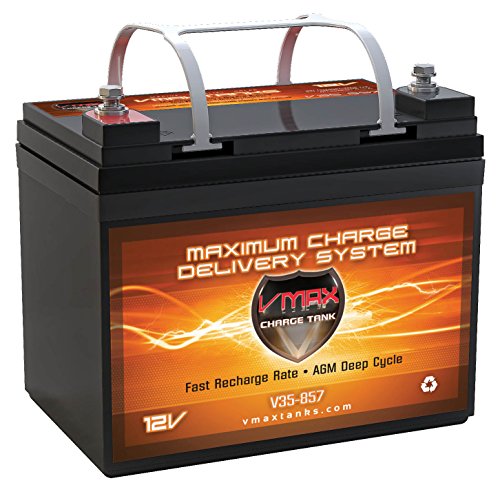
| 5. VMAX V35-857 — Compact AGM for Kayaks and Small Boats |
| Check price on Amazon |
Key takeaways
- Find the best AGM marine battery for starting, trolling and house loads. We compare Optima BlueTop, Odyssey, VMAX and WEIZE AGM batteries by group size, CCA, capacity and reserve capacity.
As an Amazon Associate we earn from qualifying purchases.
A marine battery lives a harder life than a car battery. It gets pounded by chop, baked in a sealed compartment, discharged deeply by trolling motors and electronics, and then asked to crank an outboard without complaint. Absorbed glass mat (AGM) construction suits that job well: the electrolyte is held in fiberglass separators rather than sloshing free, so the battery is sealed, spill-proof, maintenance-free and far more resistant to vibration than a flooded battery. That is why AGM has become the default upgrade for starting batteries, trolling motor banks and house batteries on fishing boats, runabouts and small cruisers.
Choosing the best AGM marine battery is mostly a matter of matching three things to your boat: the job (starting, deep-cycle, or both), the physical group size your tray and cables were built for, and the numbers that describe real capacity — cold cranking amps (CCA) and marine cranking amps (MCA) for starting, amp-hours (Ah) and reserve capacity (RC) for sustained loads. This guide compares five genuine AGM marine batteries across those measures, from a compact dual-purpose starting battery to a 100Ah deep-cycle workhorse, and explains how to size and care for whichever one you pick.
Affiliate Disclosure: This article contains affiliate links. If you buy through a link on this page, we may earn a commission at no extra cost to you.
Quick Comparison
| Product | Type | Group size | Key ratings | ASIN |
|---|---|---|---|---|
| OPTIMA D34M BlueTop | Dual-purpose AGM | 34M | 750 CCA, 55Ah, 120 min RC | B00075OSCO |
| Odyssey 34M-PC1500 (ODX-AGM34M) | Dual-purpose AGM (TPPL) | 34M | 850 CCA, 68Ah, 135 min RC | N/A |
| VMAX MR107-85 | Deep-cycle AGM | 24 | 85Ah, 160 min RC | N/A |
| WEIZE Deep Cycle AGM 12V 100Ah | Deep-cycle AGM | — | 100Ah, 1150A max discharge | B07SW353M8 |
| VMAX V35-857 | Deep-cycle AGM | U1 | 35Ah | B076584FY7 |
1. OPTIMA D34M BlueTop — Best Dual-Purpose All-Rounder
- Best for: Single-battery boats that need one AGM to start the engine and run everyday electronics.
Single-battery boats that need one AGM to start the engine and run everyday electronics.
The BlueTop line is OPTIMA’s marine and RV family, and the D34M is its dual-purpose model: one battery that both starts the engine and runs accessories. The listing specifications are well documented: 12 volts, 750 cold cranking amps, 870 marine cranking amps, a 55Ah C20 capacity, and a reserve capacity of 120 minutes, in a case measuring 10.06 by 6.88 by 7.94 inches and weighing 43.5 pounds. Terminals are dual — SAE posts plus 5/16-inch stainless steel studs — which makes it easy to land both engine cables and accessory leads without stacking everything on one post.
The D34M’s defining technology is OPTIMA’s SpiralCell design, which winds the pure-lead plates into spiral cells instead of stacking flat plates. OPTIMA rates its AGM batteries as far more vibration-resistant than conventional designs, and the sealed case can be mounted in almost any position, a real advantage in tight center-console compartments. For a single-battery boat — a typical bass boat, bay boat or runabout that starts the motor and powers a fishfinder, livewell and lights from the same bank — the D34M is the simplest correct answer: strong cranking, honest deep-cycle ability, and a group 34 footprint that fits the trays on a wide range of boats.
Its limits follow from its size. At 55Ah it is a dual-purpose battery, not a high-capacity house bank; anglers running a 24- or 36-volt trolling motor will still want dedicated deep-cycle batteries for the motor. It also needs an AGM-compatible charger profile, as do all batteries in this guide.
2. Odyssey 34M-PC1500 (ODX-AGM34M) — Premium Cranking and Deep Cycling
ASIN: N/A — the 34M-PC1500 is sold through Odyssey dealers and marketplaces under the current ODX-AGM34M name, but we could not confirm a current Amazon US ASIN for the marine 34M version at the time of writing, so verify the exact model name on any listing before buying.
Odyssey builds its Extreme series around thin plate pure lead (TPPL) AGM technology, and the manufacturer’s data sheet for this battery shows why it sits at the premium end of the marine market: 850 CCA, 1050 MCA, a pulse hot cranking rating of 1500 amps, 68Ah of capacity at the 20-hour rate, and 135 minutes of reserve capacity. Odyssey rates the design for up to 400 cycles at 80 percent depth of discharge, a deep-cycling figure most starting batteries cannot approach, and the sealed, non-spillable case can be mounted in any orientation except inverted.
Physically it is a group 34M battery of about 10.85 by 6.76 by 7.95 inches and 49.5 pounds, with SAE posts and marine stud terminals. The pure-lead plates also give it a notably long shelf life — Odyssey’s data sheet cites up to two years of storage at room temperature before a top-up charge is needed — which suits boats that sit through a winter layup. If your boat has one battery position and you demand the strongest combination of cold-weather starting, reserve power and cycle life that fits a group 34 tray, this is the battery the numbers point to. The trade-off is simply that premium construction costs more and weighs more than the alternatives of the same size.
Best for: Boaters who want maximum cranking power and deep-cycle endurance in a single group 34M battery, and boats stored for long off-seasons.
3. VMAX MR107-85 — Deep-Cycle Runtime for Trolling Motors
ASIN: N/A — the MR107-85 is listed on Amazon US as a VMAXtanks AGM deep-cycle marine battery, but we could not confirm its current ASIN at the time of writing, so check the listing title names the MR107-85 and group 24 size before ordering.
The MR107-85 is a purpose-built deep-cycle AGM from VMAXtanks’ marine line: 12 volts, 85Ah of capacity and a reserve capacity of about 160 minutes in a group 24 case measuring 10.2 by 6.6 by 8.5 inches and weighing about 55 pounds, with 8mm terminals. VMAX describes heavy-duty plates and an electrolyte suspension system designed for shock and vibration resistance, and the maker publishes trolling-motor runtime guidance for the battery — for example, running a 55-pound-thrust motor for roughly 7.3 hours at low speed, 4.4 hours at medium and 1.5 hours at maximum, which gives a practical feel for what 85Ah means on the water.
This is the right shape of battery for a trolling motor bank: wire two in series for a 24-volt motor or three for 36 volts, and the sealed AGM design means no watering, no acid spills in the bow compartment, and no corrosion creeping over the terminals between trips. It is not a starting battery — it publishes no CCA rating and is not sold for cranking — so pair it with a proper starting or dual-purpose battery for the engine rather than asking it to do both jobs.
Best for: Dedicated trolling motor banks and house loads on fishing boats that already have a separate starting battery.
4. WEIZE Deep Cycle AGM 12V 100Ah — High Capacity for House Banks
- Best for: House banks, overnight anchor loads and high-capacity 12-volt trolling setups where runtime matters more than cranking.
House banks, overnight anchor loads and high-capacity 12-volt trolling setups where runtime matters more than cranking.
WEIZE’s 100Ah deep-cycle AGM is the capacity pick in this guide. The listing describes a sealed, maintenance-free 12-volt battery rated at 100Ah, with a low self-discharge rate of about 3 percent per month, a maximum discharge current of 1150 amps, and dimensions of 12.99 by 6.73 by 8.43 inches at 57 pounds. WEIZE lists trolling motors and marine use among its intended applications, alongside RV, solar and off-grid systems, and the battery carries a 1-year warranty according to the maker’s materials.
On a boat, a battery like this earns its place as a house battery: running a refrigerator, cabin lights, pumps, a fishfinder suite and phone charging overnight at anchor, or feeding a single 12-volt trolling motor on a smaller fishing boat where one big deep-cycle battery is simpler than a pair. The sealed AGM build means it can live under a berth or in a console without venting concerns of a flooded battery, and the low self-discharge helps it survive between trips without a maintainer — though a smart AGM charger remains the right habit.
Two cautions apply. First, like the VMAX above, this is a deep-cycle battery without a published marine cranking rating, so do not buy it as an engine-starting battery. Second, at 100Ah in lead-acid form it is heavy; confirm your tray space and cable lengths against its dimensions, which are close to a group 31 footprint, before ordering.
5. VMAX V35-857 — Compact AGM for Kayaks and Small Boats
- Best for: Kayaks, canoes and small boats with light trolling motors, and dedicated electronics batteries.
Kayaks, canoes and small boats with light trolling motors, and dedicated electronics batteries.
Not every boat needs a 50-pound battery. The VMAX V35-857 is a 12-volt, 35Ah AGM deep-cycle battery in the small group U1 size, listed by VMAXtanks for electric trolling motors of around 30 pounds of thrust — the class of motor used on kayaks, canoes, inflatables and small jon boats. Its Amazon listing identifies the model (manufacturer part VMAX857 TM) and its role as a sealed AGM marine deep-cycle battery.
Thirty-five amp-hours will not push a bass boat, but on a kayak it runs a small trolling motor, fishfinder and lights for a day of fishing while keeping total weight manageable, and the sealed AGM case tolerates the splashing and tilting that small craft dish out. It is also a sensible fishfinder and electronics battery on larger boats that keep electronics on a separate small bank to isolate them from engine-start voltage dips. As with the other deep-cycle picks here, it is not a cranking battery.
How to Choose the Best AGM Marine Battery
Start with the job, not the brand. A starting battery is rated in CCA and MCA and is built for short, huge bursts. A deep-cycle battery is rated in amp-hours and reserve capacity and is built for long, steady draws. A dual-purpose battery, like the OPTIMA D34M and the Odyssey 34M, splits the difference. Most trailer boats end up with a dual-purpose or starting battery for the engine plus deep-cycle batteries for the trolling motor — buying one battery type to do both jobs badly is the most common mistake in this category.
Confirm the group size physically. Group size is the battery’s standardized footprint and terminal layout: 24, 27, 31 and 34M are the common marine sizes, and U1 covers compact batteries. Measure your tray, check the hold-down style, and note which side the positive terminal sits on before ordering; a battery that is an inch too tall for the compartment lid is a return waiting to happen.
Size capacity to the load. For trolling motors, a rough planning rule is that a motor draws about one amp per pound of thrust at full speed. An 85Ah battery like the MR107-85 therefore gives a 55-pound-thrust motor a bit over an hour at full throttle, several hours at the low and medium speeds anglers actually use, and you should plan to use only about half of a lead-acid battery’s capacity regularly to protect its lifespan. For house loads, add up the amp draw of everything you run and multiply by the hours between charges, then buy at least double that figure in amp-hours.
Check your charger before the battery arrives. AGM batteries need an AGM or sealed lead-acid charge profile; a charger that equalizes like a flooded-battery charger can shorten an AGM’s life. If your onboard charger predates AGM profiles, replacing it alongside the battery is money well spent.
Caring for an AGM Marine Battery
AGM batteries are maintenance-free in the sense that you never add water, but they are not attention-free. Charge them fully after each outing rather than storing them discharged, since leaving a lead-acid battery sitting at partial charge is the fastest route to permanent capacity loss. Use a smart charger or maintainer with an AGM setting during layup, and disconnect or switch off parasitic loads like clocks and stereo memory that quietly drain a bank over weeks. Keep terminals clean and tight, inspect cables for corrosion at the start of each season, and secure the battery with a proper hold-down — vibration is the enemy AGM resists best, but a battery bouncing loose in its tray will still damage itself and its cables. Finally, avoid routinely discharging any AGM in this guide below about half of its capacity; the Odyssey’s deeper rating is headroom for occasional use, not a daily target.
Frequently Asked Questions
Can an AGM marine battery be mounted on its side?
Generally yes. Sealed AGM batteries such as the OPTIMA BlueTop and Odyssey Extreme are described by their makers as mountable in almost any orientation, and Odyssey’s data sheet allows any orientation except inverted. Always confirm the specific model’s guidance and keep terminals protected from shorting against metal surfaces.
What is the difference between CCA and MCA?
CCA is measured at 0 degrees Fahrenheit and MCA at 32 degrees Fahrenheit, so the MCA figure for the same battery is always higher. Compare like with like when shopping: the OPTIMA D34M’s 750 CCA and 870 MCA describe the same starting strength under two different test temperatures.
How long should an AGM marine battery last?
Service life depends on depth of discharge, charging habits and heat. A dual-purpose battery used for starting and light loads commonly lasts several seasons, while a deep-cycle battery discharged gently and recharged promptly after every trip lasts longer than one regularly run flat. Odyssey rates its TPPL design for up to 400 cycles at 80 percent depth of discharge, which is at the strong end of the AGM class.
Can I replace just one battery in a trolling motor bank?
It is poor practice. In a series bank, the weakest battery limits the whole string and gets overworked, so mixing an old battery with new ones shortens the new battery’s life. Replace a 24- or 36-volt bank as a matched set of the same model and age where possible.
Do I need a special charger for AGM?
You need a charger with an AGM or sealed setting that uses the correct absorption voltage and does not apply a flooded-battery equalization charge. Most modern smart chargers and onboard marine chargers include an AGM profile.
Verdict
The best AGM marine battery depends on the seat it fills. For a single battery that must start the engine and run the boat, the OPTIMA D34M BlueTop (B00075OSCO) is the balanced default, and the Odyssey 34M-PC1500 is the premium step up in cranking power, reserve and cycle life. For dedicated trolling and house duty, the VMAX MR107-85 brings group 24 deep-cycle runtime, the WEIZE 100Ah brings the most capacity in this guide for overnight loads, and the little VMAX V35-857 covers kayaks and small craft. Match the group size to your tray, the ratings to your loads, and charge with an AGM profile, and any of these sealed batteries will outlast and out-perform the flooded battery it replaces.