Key takeaways
- The Pontiac Solstice GXP takes a BCI Group 86 battery. Compare flooded and AGM Group 86 picks by CCA, reserve capacity, terminal layout and warranty.
As an Amazon Associate we earn from qualifying purchases.
Affiliate Disclosure: This article contains affiliate links. If you buy through a link on this page, we may earn a commission at no additional cost to you. Product specifications are taken from manufacturer and retailer listings, and we have not personally tested these batteries.
Start With the Fitment, Not the Brand
The Pontiac Solstice GXP was sold for the 2007, 2008 and 2009 model years with the 2.0-liter turbocharged LNF Ecotec four-cylinder engine. Every Solstice model year, including the GXP, is catalogued with a BCI Group 86 battery. That single fact should drive the whole purchase, because a battery that is the wrong group size can fail you in three separate ways at once: the case may not sit correctly in the tray, the hold-down may not secure it, and the cables may not reach the terminals in the correct orientation.
Group 86 is a specific standardised case. Its nominal maximum dimensions are about 9 1/16 inches long, 6 13/16 inches wide and 8 inches tall, and it uses top-post terminals with the positive terminal on the left when the terminals face you. Its close relative, Group 85, shares the same case dimensions but reverses the terminal orientation, which is why a Group 85 battery is not a safe substitute even though it looks identical on a shelf. If a listing does not state Group 86, or a manufacturer-confirmed dual fitment that explicitly includes 86, treat it as the wrong battery for this car and move on.
That rule matters more for the Solstice than for many cars because battery access on this platform is awkward. On the Solstice the battery sits behind the front wheel area on the passenger side, and replacement typically involves working around the fender area rather than simply lifting a battery out from the top of an open engine bay. You do not want to discover a terminal orientation problem or a case that will not seat after you have already opened the car up. Confirm the group size, the terminal layout and the cold cranking amps before you order, and confirm them again against the label of the battery that arrives.
For electrical demand, catalogues for this car generally list Group 86 batteries in the range of roughly 650 cold cranking amps for the stronger versions, with reserve capacity around 90 to 100 minutes. The GXP does not have an unusually large engine to turn over, but it is a turbocharged, direct-injected engine that needs clean, stable voltage for its engine management, fuel system and ignition. A weak battery on a GXP often shows up first as slow cranking, electrical oddities or warning lights rather than a clean no-start, so choosing a battery that meets or exceeds the typical Group 86 ratings for this application is sensible rather than extravagant.
Our Group 86 Picks for the Solstice GXP
Every pick below is a 12-volt automotive starting battery in BCI Group 86, or in one case a manufacturer-designated dual 75/86 fitment that we flag clearly. We deliberately excluded popular batteries that are often recommended for this car in forum posts but are not Group 86, and we explain that exclusion further down so you can see the reasoning rather than take it on trust.
1. Interstate MTP-86 — Best All-Round Group 86 Choice
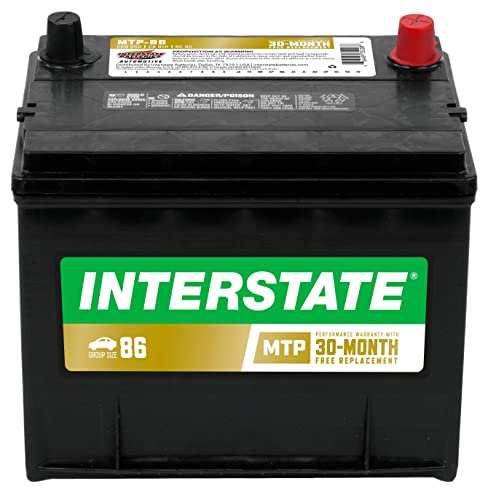
- Brand and model: Interstate Batteries MTP-86
- Group size: 86
- Cold cranking amps: 650 CCA
- Cranking amps: 810 CA
- Reserve capacity: 95 minutes
- Type: Flooded lead-acid, non-AGM
- Terminals: Top post
- ASIN: B0B89ZTPWJ (candidate — see the verification note at the end of this article)
The MTP-86 is the strongest conventional flooded option in Interstate’s Group 86 line, and on specification it lines up very well with what catalogues ask for on the Solstice. Its 650 cold cranking amps match the higher end of the ratings listed for this application, and its 95 minutes of reserve capacity give you a reasonable buffer if the car sits with lights or accessories drawing power, or if the alternator is beginning to weaken and you need to get home rather than to a parts store.
Interstate positions the MTP line above its standard MT line, with a longer free-replacement warranty period — 30 months for the MTP-86 in the manufacturer’s published material, compared with 24 months for the MT-86. Warranty length is not a performance figure, but on a car that is now well over a decade old and often used as a second or weekend vehicle, a longer replacement window has real value. Cars that sit between drives are harder on batteries than daily drivers, because the battery spends long periods in a partial state of charge.
Choose the MTP-86 if your GXP is driven in cold weather, if it has ever cranked slowly on a winter morning, or if you simply want the flooded option with the most headroom. Its main trade-off is the one shared by all flooded batteries: it is not sealed in the way an AGM battery is, and it rewards an owner who occasionally checks condition and keeps the terminals clean and tight.
2. Interstate MT-86 — The Sensible Standard Replacement
- Brand and model: Interstate Batteries MT-86
- Group size: 86
- Cold cranking amps: 525 CCA
- Cranking amps: 655 CA
- Reserve capacity: 90 minutes
- Type: Flooded lead-acid, non-AGM
- Terminals: Top post
- ASIN: N/A — review and catalogue sources reference an Amazon listing for this model, but we could not confirm a reliable Amazon US ASIN for the MT-86 from indexed listing data, so no ASIN is claimed here. Buy it by the exact part number MT-86 from a reputable battery retailer if you choose this model.
The MT-86 is Interstate’s standard Group 86 battery, aimed at dependable service in hot to moderate climates. Its 525 cold cranking amps are noticeably lower than the MTP-86, and its reserve capacity is 90 minutes rather than 95. On paper that makes it the weaker battery, and for a GXP in a cold climate we would not put it first. In a mild climate, on a car that is driven regularly and garaged, it covers the basic job of starting a 2.0-liter four-cylinder without drama.
Interstate’s own description of the MT line emphasises longer life in hot to moderate conditions, which is a plausible trade-off to make deliberately: heat is the main killer of lead-acid batteries, and a battery optimised for heat tolerance can outlast a higher-cranking battery in a hot region even though its headline numbers look smaller. If you live somewhere genuinely hot and your starting demands are modest, that logic is worth weighing rather than automatically buying the largest CCA figure on the shelf.
Choose the MT-86 if your climate is warm, your car is used often, and you prefer an established national battery network for warranty support. Interstate batteries are sold and serviced through a large dealer network, which matters when a warranty claim has to be handled in person with the old battery on the counter. Skip it, and step up to the MTP-86, if you regularly start the car in freezing temperatures or if the car sits unused for weeks at a time.
3. DieHard Gold 86-2 — Strong Catalogue Numbers, Retailer Route
- Brand and model: DieHard Gold, part 86-2
- Group size: 86
- Cold cranking amps: 650 CCA
- Cranking amps: 810 CA
- Reserve capacity: 100 minutes
- Type: Flooded lead-acid
- Terminals: Top post
- ASIN: N/A — this battery is catalogued and sold through Advance Auto Parts; we found no reliable Amazon US listing for the 86-2, so no ASIN is claimed. Buy it by part number 86-2 from that retailer or an authorised seller.
On specification alone, the DieHard Gold 86-2 is the strongest flooded pick in this list. It matches the MTP-86 at 650 cold cranking amps and 810 cranking amps, and it edges ahead on reserve capacity at 100 minutes. Advance Auto Parts describes the DieHard Gold line as engineered for maximum starting power across climates and as meeting or exceeding the vehicle manufacturer’s CCA and reserve capacity requirements, and for the Solstice application those numbers support that description.
The practical argument for the DieHard is the buying experience rather than the label. A large auto parts retailer can test your old battery, confirm the fitment against the vehicle in its catalogue, hand you the correct Group 86 unit, and handle the core return in the same visit. For a car with awkward battery access, having the fitment double-checked by a counter catalogue before you start work is genuinely useful, and if the battery fails early, a local store is usually easier to deal with than a shipped return of a heavy lead-acid battery.
Choose the DieHard Gold 86-2 if you prefer buying in person, want the best reserve capacity figure among the flooded picks here, or want store-based installation and testing services. Its limitation for readers of this guide is simply the channel: because we could not verify an Amazon US listing for it, we list it without an ASIN rather than attaching a code that belongs to a different battery.
4. Odyssey ODP-AGM75/86 — The AGM Option, With a Fitment Caveat
- Brand and model: Odyssey ODP-AGM75/86, also referenced as 75/86-705
- Group size: Dual 75/86 designation by the manufacturer
- Cold cranking amps: 708 CCA
- Reserve capacity: 89 minutes
- Capacity: 49 Ah at the 20-hour rate
- Type: AGM, thin plate pure lead
- Terminals: SAE top posts and side terminals
- ASIN: N/A — indexed sources describe this battery and link to Amazon sales channels, but we could not confirm a reliable Amazon US ASIN from the listing data available to us, so no ASIN is claimed here.
The Odyssey is the premium route. Its absorbed glass mat construction with thin plate pure lead technology delivers 708 cold cranking amps, the highest figure in this guide, and AGM batteries generally tolerate vibration, hold charge well in storage and do not require the owner to think about electrolyte levels. For a low, stiffly sprung roadster that may sit between weekend drives, those are relevant virtues rather than marketing garnish. Odyssey’s own technical data sheet for the ODP-AGM75/86 confirms the 708 CCA figure, 89 minutes of reserve capacity and 49 amp-hour capacity.
Now the caveat, stated plainly. This is a dual-designation 75/86 battery, not a single-purpose Group 86 case, and its published maximum dimensions are slightly different from the standard Group 86 envelope. Before ordering it for a Solstice GXP, verify the tray, hold-down and cable reach on your specific car, and confirm with the seller that the unit they ship is the ODP-AGM75/86 variant. If anything about the physical fit is uncertain, choose one of the true Group 86 flooded picks above instead. Power figures never compensate for a battery that does not sit securely.
Choose the Odyssey if your car sits for long stretches, if you value AGM storage behaviour and vibration resistance, and if you are willing to do the extra fitment check. Its reserve capacity is actually the lowest in this list despite the highest cranking figure, so it is a starting-power and durability choice, not a reserve-capacity choice.
Batteries We Excluded, and Why
The most common recommendation you will see for this car outside Group 86 is the Optima RedTop in Group 25. Optima’s own material acknowledges that the Group 25 RedTop is a different size from the Group 86 battery the Solstice came with from the factory, and presents it as usable with tray adaptors. It is a respected battery with 720 cold cranking amps, but it is not the factory group size, and this guide only includes batteries that match the car’s specified fitment, plus the one clearly flagged dual-designation Odyssey above. If you are comfortable modifying or adapting the tray arrangement, that is your decision as an owner — but it should be a conscious decision, not something an article quietly substitutes for the correct size.
We also excluded lithium starting batteries sold in a Group 86 case size. A lithium iron phosphate cranking battery can offer high cranking figures in a light case, but a 2007 to 2009 Solstice charging system was designed around lead-acid behaviour. Mixing a lithium starting battery with an older alternator and voltage regulation strategy raises compatibility questions that a general buyer’s guide cannot settle for your individual car, so we have stayed with lead-acid chemistries — flooded and AGM — that the car’s charging system was built for.
Finally, we excluded generic Group 86 listings where we could not tie the product to a manufacturer specification for CCA and reserve capacity. A group size alone tells you the case fits; it does not tell you the battery is strong enough or well made. Every pick above has published manufacturer or major-retailer specifications behind it.
How to Choose Between These Four
If you want one straightforward answer, take the Interstate MTP-86. It is a true Group 86 battery, it matches the stronger catalogue ratings for this car, and its warranty period is the longer of the two Interstate options. It suits the widest range of GXP owners without any fitment asterisk.
If reserve capacity is your priority — for example, the car has aftermarket audio equipment or you have been caught out by a weak alternator before — the DieHard Gold 86-2 and its 100 minutes of reserve capacity deserve the top spot, provided you are happy buying through a parts retailer rather than Amazon.
If the car is a fair-weather vehicle that sits, think hardest about storage behaviour. Any lead-acid battery in an occasionally used car benefits from a quality maintenance charger, and the AGM Odyssey tolerates that life well. But do not let chemistry enthusiasm override the physical check that its dual-size case demands.
If you are in a hot climate and the car is driven weekly, the MT-86 is a rational, lower-output choice rather than a false economy. Heat, not cold, will probably decide how long it lives.
Whichever you choose, replace like with like on the fundamentals: Group 86, top posts in the correct orientation, at least the catalogue CCA for the application, and a date code as fresh as you can find. A battery that has sat on a shelf for a long time starts its service life with a disadvantage no brand name can undo.
Installation and Safety Notes for the Solstice
Because access is tight on this platform, plan the job before you start. Photograph the cable routing, note which cable goes where, and have the correct tools for the hold-down and terminal fasteners to hand. Disconnect the negative cable first and reconnect it last. Keep the old battery upright, because a flooded battery contains sulphuric acid electrolyte, and arrange the core return at the time you buy the replacement so the old unit does not sit in your garage.
After fitting, check that the hold-down actually secures the new battery. A loose battery vibrates, and vibration shortens lead-acid battery life and can damage terminals and cables. Start the car, check for warning lights, and confirm that accessories behave normally. If the new battery was not fully charged when sold, a proper charger is a better first step than relying on a short drive to bring it up.
If your GXP repeatedly kills batteries, do not keep replacing them on a schedule and calling it maintenance. Have the charging system output and any parasitic draw measured. A roadster that sits can have a modest draw that is harmless over a weekend and destructive over a month, and no battery in this guide can outrun an electrical fault.
Verification Note
Amazon US product pages were attempted for the ASIN listed in this article and returned access denied, so that ASIN is recorded as a candidate based on indexed listing and manual data, not as live-verified. The other three picks are listed with ASIN: N/A for the reasons stated beside each one, rather than with codes we could not confirm. The duplicate-intent check against the site search for this keyword could not be completed with the tools available, so that check is recorded as incomplete in our notes rather than as evidence that no similar article exists. Confirm availability, fitment and the exact variant on the product page before you buy.