Our Short List of 3

- Model: BK-3MCCA8BA
- Chemistry: NiMH, low self-discharge
- Voltage: 1.2 V
- Capacity: up to 2,000 mAh typical

- Chemistry: NiMH
- Voltage: 1.2 V
- Capacity: 2,800 mAh per cell as rated in the listing
- Pack contents: 8 AA cells with storage cases, according to the listing
- Chemistry: NiMH
- Voltage: 1.2 V
- Capacity: 2,000 mAh
- Rated cycles: up to 1,000
All 3 Picks at a Glance
| Product | Specs | Action |
|---|---|---|
| 1. Panasonic eneloop AA, 8-pack (BK-3MCCA8BA) — best for storage and long cycle life |
| Check price on Amazon |
| 2. EBL AA Ni-MH, 8-pack, 2,800 mAh — best for high capacity per charge |
| Check price on Amazon |
| 3. Amazon Basics AA NiMH, 8-pack, 2,000 mAh — best straightforward everyday pack |
| Check price on Amazon |
Key takeaways
- Compare the best AA NiMH rechargeable batteries by capacity, cycle life, low self-discharge and device fit, with picks for everyday, storage and high-drain use.
As an Amazon Associate we earn from qualifying purchases.
A drawer full of dead single-use AA cells is a familiar problem, and it is also an avoidable one. Modern AA NiMH rechargeable batteries hold far more of their charge in storage than the rechargeables of a generation ago, they arrive pre-charged, and the better packs can be topped up hundreds or even thousands of times. The catch is that not every AA NiMH cell suits every job. A high-capacity cell that shines in a camera flash may waste its strengths in a wall clock, while a long-life, low self-discharge cell is exactly what an emergency torch or a spare remote needs.
This guide compares three proven AA NiMH options, all from listings on Amazon US, and explains the trade-offs behind the headline numbers. Specifications below are taken from the manufacturers’ and listings’ published product information, not from detailed research, so treat the capacity and cycle figures as rated claims to compare like with like. Where a figure differs between a typical and a minimum rating, both matter: the minimum is the safer planning number.
Affiliate Disclosure: This article contains affiliate links. If you buy through a link on this page, we may earn a commission at no extra cost to you. Product names, specifications and availability are taken from the sellers’ listings and the manufacturers’ published information at the time of writing, and they can change, so check the listing before you buy.
Quick comparison
| Pick | Pack | Rated capacity | Rated cycles | Shelf-charge claim | Best for |
|---|---|---|---|---|---|
| Panasonic eneloop AA (BK-3MCCA8BA) | 8 AA | 2,000 mAh typical, 1,900 mAh minimum | Up to 2,100 | Retains up to 70 percent of charge for up to 10 years | Long storage, remotes, emergency kits |
| EBL AA Ni-MH 8-pack | 8 AA | 2,800 mAh | Not stated consistently in the listing summary used here | Maintains 80 percent of capacity after 3 years of non-use | High-drain devices, cameras, toys |
| Amazon Basics AA NiMH 8-pack | 8 AA | 2,000 mAh | Up to 1,000 | Maintains 80 percent capacity for 2 years | Everyday household rotation |
1. Panasonic eneloop AA, 8-pack (BK-3MCCA8BA) — best for storage and long cycle life
- Model: BK-3MCCA8BA
- Chemistry: NiMH, low self-discharge
- Voltage: 1.2 V
- Capacity: up to 2,000 mAh typical
The standard eneloop AA is the benchmark that most other AA NiMH cells are measured against, and the reason is balance rather than a single headline figure. Its rated capacity, around 2,000 mAh typical with a 1,900 mAh minimum, sits in the middle of the AA NiMH range. What sets it apart is the combination of a very high rated cycle count — Panasonic rates this generation at up to 2,100 recharges — and unusually slow self-discharge in storage. Panasonic states that the cells retain up to 70 percent of their charge for up to 10 years when not in use, and they are pre-charged at the factory using solar-generated power, so a fresh pack is ready to work straight away.
That profile suits devices that sip power or sit idle for long stretches: television and streaming remotes, wireless keyboards and mice, clocks, game controllers that are used in bursts, and the torch in an emergency kit that may not be touched for months. In those jobs, a cell that is still charged when you finally reach for it beats a higher-capacity cell that has quietly drained on the shelf.
There are limits to keep in mind. If your main use is a hungry device — a hot-shoe camera flash recycling as fast as it can, or a toy that runs motors for an hour at a time — a higher-capacity cell will usually give you longer runs between charges. The eneloop can certainly power those devices, and many photographers keep a set for exactly that, but capacity per charge is not its strongest card. It is also worth using a good smart charger that terminates correctly for low self-discharge cells, rather than an old timed charger that can overcook any NiMH cell and shorten its life.
Choose this pack if: you want one dependable set for remotes, controllers and emergency gear, you value charge retention over months and years, and you would rather recharge less often because the cells were still ready when needed.
2. EBL AA Ni-MH, 8-pack, 2,800 mAh — best for high capacity per charge
- Chemistry: NiMH
- Voltage: 1.2 V
- Capacity: 2,800 mAh per cell as rated in the listing
- Pack contents: 8 AA cells with storage cases, according to the listing
The EBL 8-pack leads this shortlist on rated capacity. At 2,800 mAh per cell as stated in its Amazon US listing, it claims noticeably more energy per charge than the 2,000 mAh class represented by the other two picks. The listing also describes improved low self-discharge behaviour, stating that the cells maintain 80 percent of capacity after three years of non-use, and that they come partially pre-charged so they can be used immediately, although a full charge before first serious use is the sensible routine for any partially charged pack.
In practical terms, capacity is the figure that matters most when a device drains a set in a single session. Digital cameras, camera flashes, radio-controlled toys, handheld games, portable audio recorders and motorised gadgets all reward the extra milliamp-hours, because the alternative is swapping cells mid-task. The included storage cases in the listing are a small but real plus for this kind of use: charged and spent sets are easy to mix up in a camera bag, and a case keeps a matched set together.
Balance that against two cautions. First, high-capacity NiMH cells in general tend to trade some cycle life and some storage retention for their extra capacity, so read the current listing’s cycle claim carefully rather than assuming the longest numbers in this guide apply here. Second, rated capacities at the top of the AA NiMH range should be compared cautiously across brands, because test conditions differ. The honest way to use this pick is as a high-capacity option from a current Amazon US listing, not as a guarantee that every cell will deliver the full rated figure in every charger and device.
EBL cells also reward disciplined handling. Keep the set together, charge the set together, and avoid mixing one EBL cell with older cells of a different brand or age in the same device. In a series string, the weakest cell limits the whole device and can be driven into reverse charge when the others still have energy, which is a common and preventable cause of early failure.
Choose this pack if: your devices empty a set of AAs in a day or an evening, you want the highest rated capacity in this guide, and you are willing to manage sets carefully to get the benefit.
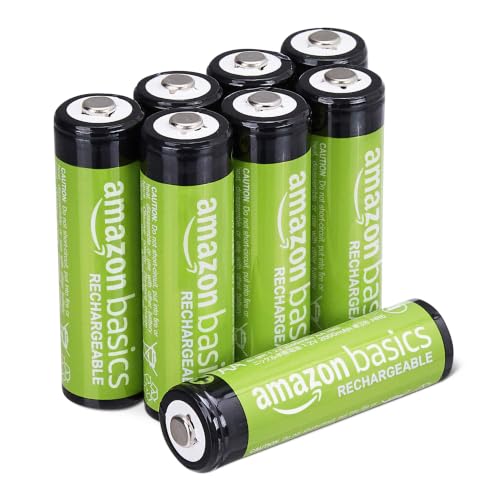
3. Amazon Basics AA NiMH, 8-pack, 2,000 mAh — best straightforward everyday pack
- Chemistry: NiMH
- Voltage: 1.2 V
- Capacity: 2,000 mAh
- Rated cycles: up to 1,000
The Amazon Basics 8-pack is the plain, well-specified middle option. Its listing describes a 2,000 mAh AA NiMH cell that can be recharged up to 1,000 times, arrives pre-charged and ready to use, and maintains 80 percent of its capacity for two years thanks to its low self-discharge design, with a stated shelf life of up to five years. Those are not chart-topping numbers in any single column, but together they cover what most households actually need: enough capacity for remotes, flashlights, clocks, toys and controllers, a long rated cycle count, and charge that survives a spell in a drawer.
This is also the easiest pick to build a simple system around. Buy two packs, keep one set in devices and one set charged as spares, and rotate them. Because the cells are a standard 1.2 V NiMH design, they work in the wide range of smart NiMH chargers that charge AA cells individually, and individual charging matters: it lets the charger finish each cell properly instead of treating a mismatched pair as one unit.
One compatibility note from the listing itself is worth repeating. NiMH cells deliver 1.2 V rather than the 1.5 V of a fresh alkaline cell, so a small number of devices that are unusually sensitive to voltage — some older gadgets and a few devices with crude low-battery gauges — may report a low battery sooner or behave oddly. That is a NiMH-wide point, not a fault of this pack, and the listing advises checking device compatibility with 1.2 V Ni-MH batteries. For the overwhelming majority of modern AA devices, 1.2 V rechargeables are the intended, economical choice.
Choose this pack if: you want a simple, pre-charged everyday set for the whole house, you plan to rotate two packs, and you do not need either the longest storage claim or the highest capacity claim in this guide.
How to choose AA NiMH batteries without wasting money
Capacity is only one number
Milliamp-hours describe how much charge a cell can deliver, but real runtime also depends on how hard the device draws current. A remote may run for a year on any of these cells, while a flash gun will separate them in an afternoon. Match the pick to the drain: high capacity for high drain, long shelf retention for low drain and storage.
Cycle life changes the real cost per use
A cell rated for many more cycles can be the cheaper and less wasteful choice over years even if its capacity per charge is lower. The eneloop’s rated cycle count is its strongest argument, while a 1,000-cycle rating, as on the Amazon Basics pack, is still far beyond what most households will use before a device itself is retired.
Low self-discharge is the feature that changed rechargeables
Older NiMH cells could lose a large share of their charge in weeks, which is why many people gave up on rechargeables for remotes and torches. All three picks here are low self-discharge designs with multi-year retention claims in their listings. That single feature is what makes modern AA NiMH practical for occasional-use devices, not just for gadgets you charge every week.
Voltage: 1.2 V is normal, and usually fine
Every NiMH AA is nominally 1.2 V. Devices designed for alkaline cells usually work well because an alkaline cell spends much of its life falling through the same voltage range. If a manufacturer specifically warns against rechargeables, follow that warning, but do not reject NiMH for a device simply because the number differs from an alkaline cell’s starting voltage.
Charger choice matters as much as cell choice
Use a smart charger that detects the end of charge for each cell, ideally one that can charge cells individually and that offers a refresh or discharge function for older sets. Avoid leaving NiMH cells on a basic charger for days, avoid fast charging a set before every use when a slower charge will do, and store charged spares in a case so terminals cannot short against keys or coins.
Keep sets matched
Label packs by purchase date, keep a set together through its life, and retire a set together when run times fall. Mixing a tired cell with fresh cells in a four-cell device makes the fresh cells look bad and can damage the tired one. Most disappointing rechargeable experiences trace back to mixed sets and poor chargers rather than to the chemistry itself.
Safety and care basics
NiMH is a comparatively forgiving chemistry, but it still stores energy. Do not puncture, crush, incinerate or short-circuit cells. Charge only in a charger intended for NiMH, never in a charger made only for lithium cells, and never attempt to recharge a single-use alkaline AA. Keep cells dry, store them away from extreme heat, and recycle spent or damaged cells through a battery recycling route rather than household waste. If a cell becomes unusually hot, swells, leaks or is damaged, stop using it and recycle it.
For long storage, low self-discharge cells can be stored charged, which is their main convenience. For a working set, a simple rhythm works well: charge, use, and when the device slows or dims, swap the whole set for the charged spare set and recharge the removed set promptly rather than leaving it flat for months.
Frequently asked questions
Can AA NiMH batteries replace alkaline AA batteries in every device?
In most devices, yes. The main exceptions are devices whose makers specifically prohibit rechargeables, devices that need the higher starting voltage of alkaline or lithium primary cells for a critical function, and some smoke or safety devices where you should follow the device manual exactly. When in doubt, the device manual outranks any battery guide.
Why do my rechargeables seem to run out quickly in one device?
Usually because that device is high-drain, because one cell in the set is weaker than the rest, or because the device’s battery gauge is calibrated for alkaline voltage and reports empty early. Test the set in a low-drain device, charge cells individually, and keep sets matched before blaming the pack.
How many packs should a household start with?
Two packs is the practical minimum for a rotation: one in use, one charged and ready. Households with cameras, flashes or many controllers often keep a third high-capacity set dedicated to those devices, which is where a pack like the EBL set earns its place.
Should I choose high capacity or high cycle life?
Choose high capacity when a single session drains a set, and high cycle life with strong shelf retention when devices are used occasionally over a long period. Many homes end up with both: a long-life standard set for remotes and emergency gear, and a high-capacity set for the camera bag or toy box. That split is exactly what the three picks in this guide are built to cover.
Verdict
For most readers, the Panasonic eneloop AA 8-pack (B00JHKSN5I) is the safest single recommendation: its rated cycle life and long shelf-charge retention make it the set most likely to be ready whenever it is picked up. If your devices burn through AAs quickly, the EBL 2,800 mAh 8-pack (B00HSHLC82) offers the highest rated capacity here. If you simply want a pre-charged everyday pack with clear, balanced specifications, the Amazon Basics 2,000 mAh 8-pack (B00CWNMV4G) covers the basics well. All three are candidate picks based on their indexed Amazon US listings at the time of writing, so confirm the current listing, pack size and specifications before ordering.