Key takeaways
- Compare battery operated propane detectors and handheld leak sniffers by sensor range, probe reach, alarm type and battery format for home and RV checks.
As an Amazon Associate we earn from qualifying purchases.
Propane gives little warning when a fitting loosens. The gas is heavier than air, so it can pool low around a tank, a regulator, an RV refrigerator or a workshop heater instead of drifting away, and a connection that was tight last season can weep after vibration, a tank swap or a cold night. A battery operated propane detector solves the practical part of that problem: you can carry it to the exact joint you suspect, with no outlet, no wiring and no waiting for a fixed alarm to notice a problem across the room.
There are two different jobs hidden inside this search, and separating them is the most important decision in this guide. A handheld leak sniffer, which is what all three picks below are, is a spot-check tool. You switch it on in clean air, let it warm up, and move its sensor slowly along valves, hoses and fittings to find where gas is escaping. A fixed propane alarm, by contrast, monitors a room or an RV continuously. A sniffer does not replace a fixed alarm, and a fixed alarm cannot pinpoint a leaking joint the way a sniffer can. Many propane users sensibly own both; this guide covers the battery powered sniffers that locate the leak.
Specifications below come from the manufacturers’ manuals and the Amazon US listings for these models, not from detailed research. Detection ranges for this class of sensor are usually quoted against methane, so treat the parts-per-million figures as a comparison scale rather than a promise about propane readings in every condition.
Affiliate Disclosure: This article contains affiliate links. If you buy through a link on this page, we may earn a commission at no extra cost to you. Product names, specifications and availability are taken from the sellers’ listings and the manufacturers’ published information at the time of writing, and they can change, so check the listing before you buy.
Quick comparison
| Pick | Power | Detection range (methane basis) | Probe | Alarm | Best for |
|---|---|---|---|---|---|
| TopTes PT199 | 2 AAA batteries, included | 50 to 1,000 ppm, dual sensitivity | No flexible probe, pen-style body | Audible and visual, bar graph and colour-changing screen | Quick checks of visible fittings |
| Techamor Y201 | 3 AAA batteries, not included | Combustible gas sniffer, see listing for current range | Flexible gooseneck sensor neck | Sound and LED alarm | Reaching behind appliances and into cabinets |
| Kiprim GD01A | Battery powered, batteries included per listing title | Combustible gas detector with high and low sensitivity modes | Compact handheld body | Audible and visual alarm | A simple included-batteries starter sniffer |
1. TopTes PT199 — best compact sniffer for visible fittings
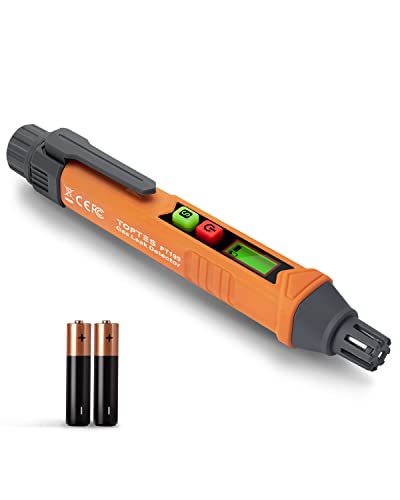
- Model: PT199
- Power source: 2 AAA batteries, included in the package according to the manual and listing
- Sensor type: gas sensitive semiconductor
- Detection range: 50 to 1,000 ppm, based on methane
- Dimensions: about 6.5 inches long, pen-style
The PT199 is the pocket option in this guide. Its manual describes a compact, pen-style combustible gas detector for natural gas, methane, propane, butane and LPG, with two sensitivity settings: a high-sensitivity mode covering roughly 50 to 500 ppm and a low-sensitivity mode covering roughly 500 to 1,000 ppm, both quoted on a methane basis. A seven-bar visual graph rises with concentration, the screen background changes from green toward red at higher levels, and an audible alarm of about 75 dB intensifies as gas increases, so you get both a sound cue and a screen cue while your eyes stay on the fitting.
Practical details are well judged for a tool that lives in a drawer. Warm-up takes about 30 seconds in clean air. The detector switches itself off after about five minutes without operation or detection, which saves the two AAA batteries, and a low-battery indicator appears when voltage falls below the level stated in the manual. The package listed in the manual includes the detector, a storage bag, two AAA batteries and a user manual.
The trade-off is reach. There is no flexible probe, and the manual puts the effective detection distance at roughly 1 to 5 cm from the source, so you need to get the body of the unit itself close to every joint. Around an RV propane locker, a grill regulator or an exposed water-heater valve that is easy. Behind a stove or inside a deep cabinet, it can mean moving the appliance or your own position rather than bending a neck into the gap. Its upper range is also lower than that of larger gooseneck sniffers, which matters less for finding a leak — leaks announce themselves well before the top of the scale — than for gauging a strong one.
One manual note deserves emphasis: the maker recommends alkaline AAA cells and warns that 1.2 V rechargeable cells may not provide sufficient voltage for correct operation. Follow that guidance for this model rather than assuming every battery chemistry behaves the same in every detector.
Choose this pick if: your propane fittings are accessible, you want the smallest detector that still gives a numeric-style bar readout, and you value included batteries and an auto shut-off.
2. Techamor Y201 — best for reaching awkward joints
- Model: Y201
- Power source: 3 AAA batteries, not included
- Probe: flexible sensor neck, described in listings at about 12 inches for this style of Y201 detector
- Alarm: sound and LED alarm
The Y201 takes the opposite approach to the PT199: instead of shrinking the body, it puts the sensor on the end of a flexible gooseneck. That single design choice changes where you can check. The neck bends into the back of a water heater, along the underside of an RV refrigerator vent, behind a grill manifold, or down toward a low fitting where propane would collect, while your hand and the alarm body stay outside the cramped space. For propane work specifically, where the suspect joints are so often low, rear-facing or enclosed, reach is not a luxury feature.
Listings for the Y201 describe it as a portable combustible gas sniffer for methane, propane, LPG, LNG, fuel and sewer gas, powered by three AAA batteries, with sound and LED alarms that respond as the sensor approaches a leak. Battery life for this style of detector is limited compared with a pen-style unit — the related listing information for the Y201 design quotes a working window measured in hours rather than days — so treat it as a tool you switch on for a check, not a monitor you leave running. Keep spare AAA cells with it, because a sniffer with flat batteries at the moment you smell gas is no sniffer at all.
Using a gooseneck well takes a little technique. Switch on in fresh air away from the suspected leak, allow the warm-up the manual specifies, then move the sensor tip slowly — a slow sweep, pausing at each joint — because semiconductor sensors need a moment to react and to clear. Work from the tank valve outward along every connection: regulator, pigtail, manifold, appliance valves and any flare or threaded joint you can reach. If the alarm rises, slow down further and let the increasing alarm rate guide you to the exact point rather than waving the probe through the cloud.
Choose this pick if: your fittings hide behind appliances or inside compartments, you check RV or workshop propane runs regularly, and you are happy to supply your own AAA batteries in exchange for reach.
3. Kiprim GD01A — best simple starter sniffer with batteries included
- Model: GD01A
- Power source: battery powered; the Amazon US listing title states batteries are included
- Sensitivity: high and low sensitivity modes, according to the listing
- Alarm: audible and visual
The Kiprim GD01A is the straightforward option: a portable gas leak tester whose listing highlights audible and visual alarms, high and low sensitivity modes for locating combustible sources, and detection coverage that includes LPG, methane, ethane, propane, butane, natural gas, coal gas and LNG. The listing title states that batteries are included, which makes it the lowest-friction way to put a working sniffer in a kitchen drawer or an RV tool kit on day one.
A note on the listing details is warranted, because the indexed listing information for this model is not perfectly consistent about battery size and count across its fields. Before ordering, confirm the current listing’s battery type, what is in the box, and the warm-up and sensitivity instructions, and then follow the manual in the box over any summary, including this one. That caution applies to budget sniffers generally: the hardware class is well established, but box contents and bundled cells change between production runs.
In use, the GD01A follows the same routine as the other picks. Start in clean air, warm up, select the sensitivity that suits the job — high sensitivity to find a faint leak, lower sensitivity to narrow in on a stronger one without the alarm saturating immediately — and sweep slowly along fittings. Dual-mode sensitivity is genuinely useful here: start wide and sensitive, then step down as you close in, the same way you would zoom a map.
Choose this pick if: you want an uncomplicated first sniffer for occasional home and RV checks, you prefer a listing that includes batteries, and you will verify the current box contents on the listing before buying.
Handheld sniffer or fixed alarm: do not confuse them
This distinction keeps people safe, so it is worth stating plainly. None of the three picks above is a continuous propane alarm. They have no role guarding a room while you sleep, because they are switched off, stored in a drawer, or shut themselves down after minutes to save battery. If your need is continuous protection in an RV, a cabin or a room with a propane appliance, you need a fixed propane alarm designed and listed for that purpose, installed at the height its maker specifies — low for propane, because propane sinks — in addition to, not instead of, a handheld sniffer for pinpointing leaks.
The same applies to carbon monoxide. A combustible gas sniffer does not detect carbon monoxide, and the PT199 manual says so explicitly for its model. Propane appliances can produce carbon monoxide when they burn badly, so a home or RV with fuel-burning appliances needs a proper carbon monoxide alarm as a separate device. Buying a sniffer and believing you have covered every gas risk is the one genuinely dangerous mistake in this category.
How to check a propane system with a battery sniffer
First, respect the obvious safety rule: if you smell strong gas, hear hissing, or suspect a large leak, do not start a methodical inspection. Turn off the tank valve if you can do so safely, avoid switches, flames and sparks, ventilate, leave the area and call your gas supplier or emergency services. A sniffer is for faint, suspected, hard-to-locate leaks, not for emergencies.
For a routine check, switch the detector on outdoors or in air you know is clean, and let it complete its warm-up. Begin at the tank: valve stem, pressure relief area and the connection to the regulator. Move slowly to the regulator body and vents, then along each hose, checking the full length for chafed or cracked sections as you go, and pause at every fitting. Continue to each appliance in turn. Propane pools low, so check low points, enclosed compartments and the floor of a locker, not just the fitting itself.
When the alarm responds, do not stop at the first reaction. Slow down, move away until the alarm clears, then approach again from a different direction. The point where the alarm rises fastest and strongest is your leak. Mark it, close the tank valve, and have the joint remade or the part replaced; a sniffer finds leaks, it does not fix them. A traditional soapy-water check on the suspect joint is a good visual confirmation, with bubbles showing the escape, but never use a flame to look for a leak.
Finally, note the date and the result. A system that passes today after a tank change should be checked again after the next tank change, after any appliance work, and at the start of each season for RV and grill setups. Vibration in travel is a common cause of loosened fittings, so a quick sniffer pass after a long tow is cheap insurance.
Buying factors that actually matter
Probe versus pen. Decide by your fittings, not by preference. Accessible valves suit a pen-style unit like the PT199; enclosed, low or rear fittings reward the Y201’s flexible neck.
Sensitivity modes and range. Two sensitivity levels make a sniffer easier to use across faint and strong leaks. Remember that ranges are quoted on a methane basis for this class, so compare models on the same basis and do not over-read small numerical differences.
Alarm style. Audible alarms that speed up or intensify with concentration, paired with a visual bar or LED display, are the easiest to work with in noisy or bright conditions. All three picks combine sound with a visual signal.
Battery format and discipline. Every pick here runs on ordinary AAA cells, which are easy to carry as spares. Check whether batteries are included, follow any maker guidance about alkaline versus rechargeable cells, and store spares with the detector. Auto shut-off, as on the PT199, protects against a drained pack after an accidental switch-on.
Warm-up and sensor care. Semiconductor sensors need a short warm-up in clean air and can be confused by starting the device inside the gas cloud you are hunting. Store the detector dry, keep the sensor away from silicone sprays, solvents and heavy fumes that can degrade this sensor type, and re-check the manual’s storage guidance for your model.
Frequently asked questions
Can a battery operated propane detector stay on all the time?
A handheld sniffer is not designed for that. Battery life is measured in hours of active use, and models like the PT199 shut down automatically after minutes of inactivity. For continuous monitoring, install a fixed propane alarm made for that purpose and use the sniffer to locate leaks when the alarm or your nose raises a question.
Where should I check first when I suspect a leak?
Start where connections are made and remade: the tank valve and regulator, especially after a tank swap, then work outward along hoses to each appliance. Those joints move, vibrate and are handled most often, so they fail most often.
Does a propane sniffer also detect natural gas and carbon monoxide?
Propane sniffers in this class generally also respond to other combustible gases such as methane and natural gas, because they use a combustible gas sensor, and the listings for all three picks describe that broader coverage. Carbon monoxide is different: it is not a combustible gas in this sense, these sniffers do not detect it, and you need a dedicated carbon monoxide alarm for that risk.
How close does the sensor need to be?
Close. The PT199 manual, for example, puts effective detection at roughly 1 to 5 cm from the source. A sniffer waved around the middle of a room will miss a small fitting leak; slow, close passes along each joint are the whole technique.
Verdict
Choose the Techamor Y201 (B07BM1XWB8) if reach decides your checks, because its flexible neck gets a sensor to the low, enclosed fittings where propane leaks hide. Choose the TopTes PT199 (B0B62LBZPC) if your fittings are visible and you want the most compact tool, with included AAA batteries, dual sensitivity and a clear bar-graph readout. Choose the Kiprim GD01A (B0D3F2YXDL) for a simple starter sniffer with high and low sensitivity modes and batteries included per its listing. All three are candidate picks based on their indexed Amazon US listings and manufacturer information at the time of writing, so confirm the current listing, box contents and specifications before ordering — and pair whichever you choose with a fixed propane alarm and a carbon monoxide alarm where continuous protection is needed.