Key takeaways
- Compare the best indoor electric composters, from FoodCycler and Lomi food recyclers to Reencle and GEME microbial machines, by capacity, cycle and output.
An indoor electric composter promises the one thing a balcony bin, a worm farm and a council food caddy cannot: scraps dealt with inside the kitchen, the same day they are made, with no smell drifting across the room. For flat dwellers, shared houses and anyone whose workspace doubles as a lunch room, that is a genuinely appealing idea. The catch is that the machines sold under this label do two very different jobs, and the marketing rarely explains which one you are buying.
Most countertop models are food recyclers. They heat, dry and grind a batch of scraps over several hours and leave a dry, soil-like material that still needs time in soil to break down fully. A smaller group works biologically: a living microbe culture sits in a large chamber, you feed it scraps daily, and it digests them continuously into something much closer to real compost. Neither approach is wrong, but they suit different households and running-cost budgets.
This guide lines up five machines that cover both camps: two sizes of FoodCycler, the app-connected Lomi 2, and two microbial machines from Reencle and GEME. Each entry states plainly what the machine actually does to your scraps, because that single fact decides whether the output can go near your plants today or needs weeks of curing first.
As an Amazon Associate, we earn from qualifying purchases.
Quick Picks
| Product | Best for | Key point |
|---|---|---|
| FoodCycler Eco 5 | Bigger households that cook daily and want the largest dryer bucket | A 5 litre batch machine with a refillable carbon filter |
| FoodCycler Eco 3 | Small kitchens that want the FoodCycler approach in a compact body | The same dry-and-grind process in a 3.5 litre bucket |
| Lomi 2 | Gadget fans who want modes, an app and a choice of cycle lengths | Three cycles, including a long low-heat mode for garden use |
| Reencle Prime | People who want output that behaves like compost, not dried scraps | A 14 litre microbial chamber that digests up to 2.2 lb a day |
| GEME 19L Electric Composter | High-volume homes that hate buying replacement filters | A 19 litre microbial machine with a permanent filter |
How to Choose
Decide which process you actually want. Batch dryers (FoodCycler, Lomi) heat and grind scraps into a dry by-product. FoodCycler calls its output Foodilizer and is honest that it is not finished compost: it should be mixed into soil and left to break down before planting. Lomi calls its output Lomi Earth and describes it as a pre-compost. Microbial machines (Reencle, GEME) keep a live culture working around the clock, and their output is much closer to compost, though both makers still recommend curing it before it feeds delicate plants. If your goal is simply keeping scraps out of the bin with zero smell, a dryer is enough. If your goal is feeding a garden, the microbial route gets you closer.
Match capacity to your scrap volume, the right way round. Dryer capacity is per batch: a 3.5 or 5 litre bucket fills, runs for hours, and only then can take more. Microbial capacity is a daily ration: the Reencle Prime digests up to about 2.2 lb of scraps a day and the GEME up to about 11 lb a day, added a little at a time. A household that cooks one big meal a day often suits a batch dryer; a household grazing through the day suits a machine that is always open for feeding.
Count the running costs, not just the machine. Dryers consume carbon filters: FoodCycler uses a refillable filter you top up with carbon, while Lomi uses replaceable filter refills and optional LomiPods. Microbial machines consume culture top-ups instead: the microbes reproduce as you feed them, and GEME says its included Kobold pack lasts around a year before small refills are needed. GEME also removes the filter cost entirely with a permanent catalytic filter. None of these consumables is ruinous, but they recur for as long as you own the machine.
Plan the space and the socket. A batch dryer needs counter room only while it runs and can live in a cupboard between cycles, though the Eco 5 is not something you will move daily. A microbial machine is a permanent resident: it stays plugged in, stays warm, and needs a spot of its own plus headroom for the lid. Measure the spot and confirm there is a socket that can stay occupied full time.
Know what each machine refuses. Dryers accept small poultry and fish bones and many accept avocado stones, but hard beef and pork bones, peach stones, nuts, candy and gum are off the menu in FoodCycler manuals. Microbial machines dislike large volumes of liquid, oil and very salty food, and both types struggle with huge single loads of citrus or onion. The manuals are the authority here, and a machine fed outside its limits is the main source of bad smells in this category.
Best Options
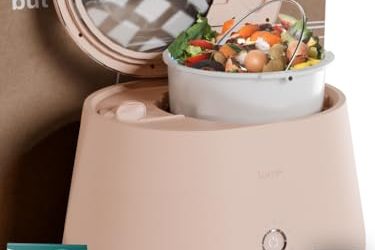
FoodCycler Eco 5

The Eco 5 is the largest of the FoodCycler dryers and the default recommendation for households that cook most days. Its 5 litre bucket takes a full day of family scraps in one load, the Vortech grinding system handles the fibrous peels, small bones and stones that jam lesser grinders, and a cycle of roughly four to nine hours reduces the load to a small volume of dry Foodilizer. The refillable carbon filter is the running-cost highlight: instead of buying cartridges, you top the filter up with fresh carbon.
Operation is a single button and a removable bucket you can carry to the counter while you cook. The honest limitations are size and output. At 13.6 kg it is a fixture once placed, the grinding phase is audible, and the output is a soil additive that needs mixing into soil and resting time, not a finished compost you can plant into the same afternoon.
Specs
- Capacity 5 litre removable bucket; batch process that heats, grinds and cools scraps into a dry by-product the maker calls Foodilizer; Vortech grinding system; refillable activated carbon filter; cycle time about 4 to 9 hours; weight 13.6 kg; colour Grey on this listing
Best for: Bigger households that cook daily and want the largest dryer bucket with the lowest filter hassle in the dryer camp
Watch out for: The output is dried, ground scraps rather than finished compost, and the unit is heavy enough that you should pick its spot once and leave it there
FoodCycler Eco 3
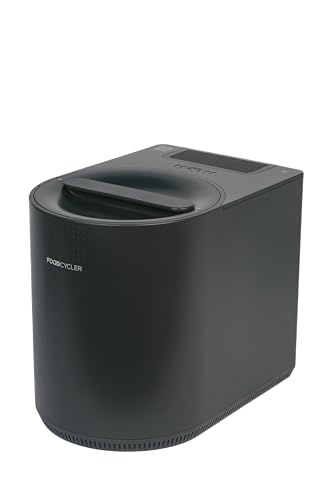
The Eco 3 takes the same FoodCycler approach and shrinks it for small kitchens. The bucket holds 3.5 litres, the body measures about 11 inches high, 9 inches wide and 13 inches deep, and the process is unchanged: load the bucket, press the button, and collect a dry, ground by-product several hours later. For one or two people, 3.5 litres covers a normal day of peels, grounds and plate scrapings without the machine dominating the counter.
What you give up against the Eco 5 is headroom and flexibility. A cooking-heavy day, a dinner party or a fridge clear-out will overflow the bucket and force a second cycle, and the output carries the same caveat as its bigger sibling: it is a soil additive that needs time in the ground, not instant compost. What you gain is a machine that fits in a cupboard and suits the way smaller households actually produce scraps.
Specs
- Capacity 3.5 litre removable bucket; batch process that heats, grinds and cools scraps into a dry by-product; Vortech grinding system; carbon filter for odour control; dimensions about 11 x 9 x 13 inches (H x W x D); colour Grey on this listing; sold by FoodCycler on Amazon
Best for: Singles, couples and small kitchens that want the FoodCycler process without the Eco 5 footprint
Watch out for: Busy cooking days will need two cycles, and the smaller bucket fills fast with bulky items like corn husks and melon rind
Lomi 2

Lomi 2 is the most appliance-like machine here: a 3 litre bucket, three distinct cycles and an app that tracks cycles and filter life. Eco-Express is the quick route for volume reduction, the standard Lomi Cycle balances time and finish, and Grow mode runs long and cooler with the optional LomiPods, aiming for an output with more biological value for garden soil. Cycle lengths run from about four hours to about a day depending on the mode you pick, and the maker rates noise below 60 dB.
The trade-offs are consumables and candour. Filters and pods are ongoing purchases, and even Lomi describes its output as a pre-compost that benefits from time in soil. In return you get the most flexible dryer in this guide, with a choice between speed on a weeknight and a slower, gentler cycle when the output is headed for the garden.
Specs
- Capacity 3 litre bucket; batch process that heats and grinds scraps; three modes (Eco-Express, Lomi Cycle and Grow) with cycle times from about 4 to 24 hours depending on mode; rated noise below 60 dB; power 500 W; app connected with cycle and filter tracking; activated carbon filtration; output described by the maker as Lomi Earth pre-compost
Best for: Gadget fans who want a choice of cycle lengths, app tracking and a long grow mode for garden-bound output
Watch out for: Filters and LomiPods are recurring costs, and the longest, most garden-friendly cycle takes most of a day
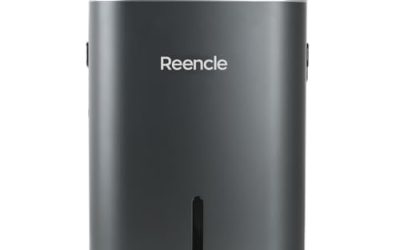
Reencle Prime

The Reencle Prime is where this guide crosses from recycling into composting. Inside its 14 litre chamber sits a living microbe culture, kept warm and turned by a slow stirring mechanism. You add scraps whenever you cook, up to about 2.2 lb a day, and the culture digests them continuously; visible breakdown happens within about a day, and the finished material can be scooped out as it accumulates. There is no batch to wait for and no bucket to empty on a schedule.
Living systems ask for living-system care. The culture needs the included microbe pack at setup, dislikes being drowned in liquid or oil, and the output should still be cured before it goes around seedlings, a step Reencle itself recommends. The machine also lives on your floor or counter permanently and stays powered. In exchange, it produces the closest thing to real compost in this guide, quietly and without the grinding phase a dryer needs.
Specs
- Chamber capacity 14 litres; continuous microbial decomposition using the Reencle Microbe culture, included as a pack in the box; throughput up to 2.2 lb of food waste per day; three-stage carbon-based odour filtration per the maker; near-silent operation per the maker; colour Silver on this listing; model Reencle Prime
Best for: People who want output that behaves like compost and a machine that accepts scraps all day rather than in batches
Watch out for: The microbe culture needs sensible feeding (go easy on liquids, oils and very salty food) and the output still benefits from curing before use on young plants
GEME 19L Electric Composter

The GEME is the heavy-duty microbial option. Its 19 litre chamber is the largest here, the maker rates it for up to 11 lb of food waste a day, and the Kobold microbe culture digests scraps continuously, with visible breakdown in roughly six to eight hours. Two design choices set it apart: the filter is a permanent catalytic unit that never needs replacing, and the lid and chamber are built for constant daily feeding rather than occasional batches.
The costs of that capacity are physical. At 42 lb it is the heaviest machine here, it needs a permanent powered spot, and its culture rewards steady, sensible feeding. For a large household, a shared house or a small office kitchen producing serious daily scraps, it is the only machine here sized for the job without running multiple cycles.
Specs
- Chamber capacity 19 litres; continuous microbial degradation using the GEME Kobold microbe pack, included in the box; maker-rated throughput up to 11 lb of food waste per day; permanent catalytic oxidation filter with no replacements; weight 42 lb; model G601N-2K
Best for: Large households and shared kitchens with high daily scrap volume that want zero filter spending
Watch out for: It is big and heavy, needs a permanent home near a socket, and the microbe culture still needs the small periodic top-ups the maker describes after the first year
Which One Fits
- Choose the FoodCycler Eco 5 if your household cooks daily, fills a big bucket of scraps, and wants a dryer with a refillable filter.
- Choose the FoodCycler Eco 3 if you cook for one or two and counter space matters more than batch size.
- Choose the Lomi 2 if you want modes, an app and a slow grow cycle for output headed to the garden.
- Choose the Reencle Prime if real compost behaviour matters most and your daily scraps fit within about 2.2 lb.
- Choose the GEME 19L if your household or shared kitchen produces scraps at a volume the others would choke on, and you never want to buy a filter again.
Common Mistakes
Believing the word composter on the box. Two of the three process types here do not make finished compost. Dryers make a dry, ground by-product that soil microbes still have to finish. Buy a dryer for odour-free volume reduction and you will be happy; buy one expecting plant-ready compost by dinner and you will not.
Overloading a microbial machine on day one. A fresh culture is a small workforce. Feeding a new Reencle or GEME its maximum daily ration immediately, especially wet or oily loads, can sour the chamber. Build up over the first weeks and let the culture establish.
Ignoring the filter and culture budget. The purchase is the beginning, not the end. Lomi filters and pods, FoodCycler carbon refills and microbial top-ups all recur. Price a year of consumables for each machine before deciding which one is actually cheaper for you.
Putting the machine where the lid cannot open. Microbial machines and dryers alike need lid clearance and a little air around them. A spot under a low cupboard that forces you to drag the unit out for every load is a spot you will stop using within a month.
Feeding bones and stones without checking the manual. Each maker draws the line in a different place: small poultry bones yes, beef bones no; avocado stones yes for some, peach stones no for nearly all. The manual for your machine is the only list that counts.
FAQ
Do indoor electric composters really make compost?
Some do and some do not. Microbial machines such as the Reencle Prime and the GEME use a living culture to digest scraps, and their output is close to compost, though both makers recommend curing it before use on delicate plants. Batch dryers such as the FoodCycler models and the Lomi 2 heat and grind scraps into a dry by-product that still needs time in soil to finish breaking down.
Will an electric composter make my kitchen smell?
A healthy machine should not. Dryers seal odours behind carbon filters, and microbial machines trap them with carbon-based filtration while the culture itself keeps smells down. Odour usually means a spent filter, an overloaded microbial chamber, or too much liquid and oil in the mix, all of which are fixable.
How much electricity do these machines use?
Batch dryers draw power for one cycle at a time: FoodCycler puts an Eco 5 cycle at about 1.5 kWh, and the Lomi 2 is rated at 500 W across cycles of varying length. Microbial machines draw a smaller amount continuously to stay warm and keep stirring. Your pattern of use matters more than the rating.
Can I put the output straight onto my plants?
For dryer output, no: mix it into soil and give soil microbes time to finish the job, following the ratio the maker suggests, because fresh output can draw nitrogen while it breaks down. For microbial output, curing for a short period first is the maker’s advice and is especially wise for seedlings and indoor pots.
Final Verdict
Pick your process first and the machine second. If you want scraps gone, dry and odour-free with the least daily thought, the FoodCycler Eco 5 is the roomy default, the Eco 3 is its compact sibling, and the Lomi 2 adds modes and an app. If you want the output to behave like compost and you are willing to keep a living culture, the Reencle Prime suits ordinary households and the GEME 19L suits heavy ones. Any of the five will keep a kitchen tidier than a caddy of ageing scraps; the right one is the one whose process matches what you plan to do with what comes out.