Our Short List of 3

- Best for: Growers switching between EC and ppm feed charts who want one numeric pen.
- Measures EC, CF, ppm 500 (TDS), ppm 700 and temperature
- EC range 0.0 to 10.0; resolution 0.1 EC
- Accuracy plus or minus 0.1 EC at 2.77 EC
- Fully waterproof and floats in solution

- Best for: Daily mixing of large reservoirs and feeding programs that run above 3.6 EC.
- Measures EC, CF, ppm 500 and ppm 700
- Range 0.4 to 6.0 EC; 4 to 60 CF
- 200 to 3,000 ppm on the 500 scale; 280 to 4,200 ppm on the 700 scale
- Factory calibrated; no calibration required
- Best for: Growers who want one rugged meter that agrees with any feed chart’s conversion.
- Measures EC, TDS and temperature simultaneously
- EC range 0 to 9,990 µS and 0 to 9.99 mS
- TDS range 0 to 8,560 ppm and 0 to 8.56 ppt
- Accuracy plus or minus 2 percent of full scale
All 4 Picks at a Glance
| Product | Specs | Action |
|---|---|---|
| Bluelab PENCON Conductivity Pen |
| Check price on Amazon |
| Bluelab Commercial Truncheon Nutrient Meter |
| Check price on Amazon |
| HM Digital COM-100 Combo Meter |
| Check price on Amazon |
 VIVOSUN pH and TDS Meter Combo |
| Check price on Amazon |
Key takeaways
- Five EC meters for hydroponic nutrient solutions compared on range, accuracy, calibration and sealing, from a no-calibration wand to a lab-style pen.
Mixing a nutrient batch forces one decision you cannot make by eye: how strong the solution actually is once the powders and liquids dissolve. Too weak and plants stall; too strong and roots burn at the tips. An EC meter turns that guess into a number, but only if its range, scale and probe suit the way you mix and check your reservoir.
This guide is for hydroponic and coco growers who mix their own feed, whether in a single tent reservoir or a larger tank topped up daily. Every meter below was picked from its Amazon listing name and specifications, with weight given to nutrient-range coverage, the scales printed on the listing, calibration demands and how the housing handles a wet grow room.
Quick Picks
As an Amazon Associate we earn from qualifying purchases.
| Product | Best for | Key spec from title |
|---|---|---|
| Bluelab PENCON Conductivity Pen | Growers who want a numeric readout on every scale | EC, CF, ppm 500 and ppm 700 on one pen |
| Bluelab Commercial Truncheon Nutrient Meter | Big reservoirs and high-strength feeding programs | 0.4 to 6.0 EC with no calibration routine |
| Apera Instruments EC60 Pocket Tester | Growers who log readings and want tight accuracy | 0 to 20.00 mS/cm with a replaceable probe |
| HM Digital COM-100 Combo Meter | Wet rooms where the meter will get dropped | EC 0 to 9,990 µS with three conversion factors |
| VIVOSUN pH and TDS Meter Combo | First setups that need pH and EC covered together | EC 0 to 9,990 µS/cm in a two-pen kit |
How to Choose
Match the Range to Nutrient Strength, Not Drinking Water
A mixed hydroponic feed usually lands somewhere between 0.8 and 2.8 EC, and concentrated stock checks can run higher, so a meter built only for faint drinking water readings wastes its resolution where you never measure. Look at where the listed range starts as well as where it ends. A wand that begins at 0.4 EC cannot confirm that your reverse-osmosis water is clean, while a pen spanning 0.0 to 10.0 EC covers source water, seedlings and full-strength bloom feed in a single tool. Pick the range around the solutions you actually dip into each week.
Know Which Scale Your Feed Chart Uses
Feed charts disagree with each other: some print targets in EC, others in ppm, and ppm itself splits into the 500 and 700 conversion scales. A reading of 1,260 ppm on the 700 scale equals roughly 900 ppm on the 500 scale, so following the wrong column quietly overfeeds a crop for weeks. Meters that show EC, CF, ppm 500 and ppm 700, or that let you select the conversion factor, remove that translation step. If your nutrient line publishes EC values, a plain EC readout is enough; if it publishes ppm, confirm which scale the meter applies before trusting its number.
Weigh the Calibration Routine and Probe Life
Most digital pens drift and need periodic calibration against a standard solution, and the honest listings say how many calibration points they accept and whether the probe can be replaced when it wears out. A replaceable probe turns a dead sensor into a small part swap instead of a whole new meter. At the other extreme, one wand design in this roundup ships factory calibrated and asks for no calibration at all, trading fine digital resolution for a routine you can never forget. Decide which burden you would rather carry before the first reservoir check arrives.
Check Waterproofing and Temperature Compensation
Nutrient solution temperature shifts conductivity, so a meter without automatic temperature compensation reports a different strength for the same tank on a cold morning than on a warm afternoon. Every pick here compensates automatically. Sealing matters just as much around open reservoirs: pens go in headfirst, get knocked off tank rims and land in the drink. A fully waterproof body that floats is a different class of insurance from a splash-resistant shell, and an IP67 housing survives the submersion that ends lesser testers. Match the sealing to how clumsy your mixing station really is.
The 5 Best Options
Bluelab PENCON Conductivity Pen
- Best for: Growers switching between EC and ppm feed charts who want one numeric pen.
- Measures EC, CF, ppm 500 (TDS), ppm 700 and temperature
- EC range 0.0 to 10.0; resolution 0.1 EC
- Accuracy plus or minus 0.1 EC at 2.77 EC
- Fully waterproof and floats in solution
Growers switching between EC and ppm feed charts who want one numeric pen.
Resolution stops at 0.1 EC, so tiny day-to-day drift inside a tenth of a point stays invisible.
The Bluelab PENCON suits growers who think in whichever unit their feed chart happens to print. One button cycles the readout through EC, CF, ppm 500 and ppm 700, so a chart written for European growers and one written for North American growers both read directly off the same dip. The range runs from 0.0 to 10.0 EC, wide enough to check plain source water in the morning and a full-strength reservoir an hour later. A backlit screen, a hold function for logging the number, and a body that floats when it slips out of a wet hand round out a pen clearly designed around open tanks.
Bluelab Commercial Truncheon Nutrient Meter
- Best for: Daily mixing of large reservoirs and feeding programs that run above 3.6 EC.
- Measures EC, CF, ppm 500 and ppm 700
- Range 0.4 to 6.0 EC; 4 to 60 CF
- 200 to 3,000 ppm on the 500 scale; 280 to 4,200 ppm on the 700 scale
- Factory calibrated; no calibration required
Daily mixing of large reservoirs and feeding programs that run above 3.6 EC.
The scale starts at 0.4 EC, so it cannot confirm low readings in source or reverse-osmosis water.
The Bluelab Commercial Truncheon removes the two chores pen owners complain about: calibrating and reading a screen. This is the extended-range version of the well-known wand, reaching 6.0 EC for high-strength programs that push past the standard model’s ceiling. There are no buttons and no display; you stir the tank with the sixteen-inch wand and read the lit scale where the lights stop. It switches itself on in solution and off again in air, arrives factory calibrated, and asks for nothing beyond a rinse. For a grower mixing a large reservoir every day, that absence of routine is the entire appeal.
Apera Instruments EC60 Pocket Tester
The Apera EC60 is the pick for growers who treat nutrient checks like lab work. Its stated accuracy of plus or minus 1 percent of full scale is the tightest in this group, and the range climbs to 20.00 mS/cm across three auto-switching scales, so the same tester reads faint seedling feed and a concentrated stock tank without manual range changes. The platinum black probe unscrews and can be replaced when it ages, and the kit arrives with calibration solutions and bottles, so the first calibration happens the day the box opens. A backlit dual display shows conductivity and temperature together.
Specs
- Measures EC, TDS, salinity and temperature
- EC range 0 to 20.00 mS/cm in three auto-switching ranges
- Accuracy plus or minus 1 percent of full scale
- Replaceable platinum black probe
- Automatic calibration at up to 3 points with buffer recognition
- IP67 waterproof body that floats; backlit dual display
- Kit includes calibration solutions, bottles, lanyard and carrying case
- Runs on 4 AAA batteries
Best for: Growers who log readings and want the closest match to a reference meter.
Watch out for: Temperature compensation covers 0 to 50 degrees C, and the larger body feels less pocket-friendly than slim pens.
ASIN: B01ESYG70K
HM Digital COM-100 Combo Meter
- Best for: Growers who want one rugged meter that agrees with any feed chart’s conversion.
- Measures EC, TDS and temperature simultaneously
- EC range 0 to 9,990 µS and 0 to 9.99 mS
- TDS range 0 to 8,560 ppm and 0 to 8.56 ppt
- Accuracy plus or minus 2 percent of full scale
Growers who want one rugged meter that agrees with any feed chart’s conversion.
Accuracy is stated at plus or minus 2 percent of full scale, looser than the Apera above.
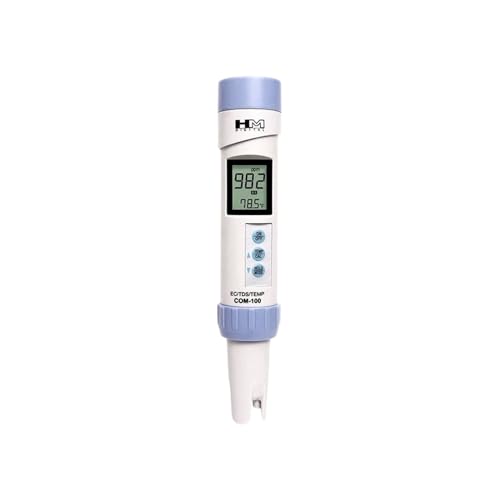
The HM Digital COM-100 is built for rooms where equipment gets wet, dropped and borrowed. The IP67 housing is submersible and floats, and the meter reads EC, TDS and temperature at once on a large screen. Its quiet advantage is conversion choice: three EC-to-TDS factors (KCl, 442 and NaCl) let you match the math behind whichever feed chart or reference table you follow, ending the argument about why two meters disagree on the same bucket. Calibration is a push-button digital routine rather than a trim screw, and the housing carries a lanyard point for hanging it beside the reservoir.
VIVOSUN pH and TDS Meter Combo
- Best for: New growers equipping a first reservoir who need pH and EC in one purchase.
- Two pens: a pH pen plus a 3-in-1 TDS, EC and temperature pen
- EC range 0 to 9,990 µS/cm; TDS range 0 to 9,990 ppm
- Accuracy plus or minus 2 percent on the EC pen
- Temperature range 0.1 to 80.0 degrees C (32.0 to 176.0 degrees F)
New growers equipping a first reservoir who need pH and EC in one purchase.
The listing notes this meter cannot test seawater, and two pens mean two caps and two storage routines to keep track of.
The VIVOSUN combo covers a first grow’s two essential checks with two separate pens: one reads pH from 0 to 14, and the second reads TDS, EC and temperature. The EC pen spans 0 to 9,990 µS/cm, which comfortably contains every nutrient strength a home reservoir should ever reach, and its stated accuracy of plus or minus 2 percent matches meters sold on their own. Automatic temperature compensation, a hold function and a plain LCD keep the routine simple while you learn how a feed responds to mixing. It is the straightforward way to stop guessing at both acidity and strength from day one.
Which One Fits Your Situation
One Tent, One Reservoir, Checked Twice a Week
The PENCON fits a small tent best. You dip one pen, read a number on whichever scale your nutrient line prints, and put it away. The floating waterproof body forgives the occasional drop into the tank, the hold function lets you log the reading under proper light, and the wide 0.0 to 10.0 EC range means the same pen checks your tap water before you mix.
Mixing a Large Tank Every Day
Choose the Commercial Truncheon. Sixteen inches of wand stirs and measures in one motion, the lit scale reads at arm’s length, and there is no calibration appointment to miss during a busy run. Its range reaches the high-strength feeds that big flowering rooms use, and automatic on-off in solution means it is always ready when the mixing starts and never left draining its batteries on the bench.
Following a ppm Chart From Another Grower
Take the COM-100. Most chart confusion comes from conversion factors, and this meter lets you select KCl, 442 or NaCl math so your number lines up with the chart in front of you instead of a stranger’s assumption. The PENCON also sidesteps the problem by printing both ppm scales directly, which suits growers who switch between two nutrient lines with different conventions.
Setting Up a First Reservoir From Scratch
Start with the VIVOSUN combo. A new grower needs pH and EC answers together, because adjusting one without knowing the other leads to chasing your tail for a week. Two simple pens, automatic temperature compensation and a hold button cover the learning phase, and you can graduate to a tighter single-purpose meter like the EC60 later, once you know which readings you rely on most.
Common Mistakes
- Comparing ppm readings across meters without checking which conversion scale each one uses, then adjusting a healthy reservoir to fix a phantom problem.
- Calibrating a pen and then storing it dry or in plain water for weeks, which shortens probe life on models that expect a storage routine.
- Measuring straight after adding concentrated nutrient, before the pump has circulated the tank, and trusting a pocket of undiluted feed.
- Buying a drinking-water TDS pen with no true EC mode, then converting its single fixed-scale ppm number by hand for every chart.
- Leaving the meter soaking in the reservoir between checks, which fouls the probe and drains batteries on designs meant for spot readings.
Frequently Asked Questions
Does an EC meter read ppm directly?
Some do and some only estimate it. EC is the actual measurement; ppm is that number multiplied by a conversion factor, either 500 or 700 depending on the scale. Meters like the PENCON print both ppm scales, while the COM-100 lets you pick the factor. Always confirm which scale a feed chart uses before comparing figures.
How often should an EC meter be calibrated?
Follow the interval in your meter’s listing and check against a standard solution whenever readings look suspicious after a drop or a long storage gap. Pens with a calibration indicator, like the PENCON’s 30-day reminder, take the guesswork out. The Commercial Truncheon is the exception here: it ships factory calibrated and has no calibration routine at all.
Why do readings change with solution temperature?
Conductivity rises as solution warms, so the same reservoir reads stronger on a warm afternoon than on a cold morning even though nothing was added. Automatic temperature compensation corrects the figure back to a reference temperature, which is why every meter in this roundup includes it. Without compensation, compare readings taken at the same time of day.
Can one meter check both source water and mixed nutrient?
Yes, if its range reaches low enough. Pens spanning from 0.0 EC, such as the PENCON and the EC60, read faint source water and full-strength feed with the same tool. The Commercial Truncheon starts at 0.4 EC, so it stays silent on clean water by design; pair it with a wide-range pen if you also monitor your supply.