Key takeaways
- Five commercial grade dehumidifiers for large basements compared by pint capacity, pump and drain setup, coverage area and cabinet size, with full specs.
A large basement puts a moisture load on a building that ordinary room units are not built to handle. The floor area is wide, the walls sit against soil that stays damp for much of the year, and the air down there is cool, which means it reaches saturation sooner. After a leak, a sump failure or a flood event, the volume of water involved can overwhelm a household machine within days. Commercial grade dehumidifiers exist for exactly this work: they move far more air, extract far more water per day, drain continuously through a pump or a hose instead of filling a small bucket, and use housings and components chosen for long, unattended runs in harsh spaces.
Disclosure: As an Amazon Associate, we earn from qualifying purchases made through links on this page, at no extra cost to you.
The five machines below are all commercial or restoration grade units sold for large basements and similar big, wet spaces. Each one removes at least 70 pints per day under the standard AHAM test condition or carries a headline capacity well above that figure, and each one drains continuously, either through a built-in condensate pump or a permanent drain hose connection. None of them is a small room unit, a desiccant mini unit or a ducted whole-house add-on.
How to read the capacity figures
Pint-per-day numbers only mean something alongside the condition they were measured at, and brands do not all use the same one. Three conditions appear across the listings in this guide. AHAM figures are measured at 80°F and 60 percent relative humidity, a realistic basement condition, and they are the most conservative numbers here. Saturation figures are measured at 90°F and 90 percent relative humidity, close to a flooded room, and they always look much larger. A few brands quote their headline figure at 95°F and 90 percent relative humidity instead, which is neither of the two above. A machine listed at 155 pints under a hot, saturated condition is not necessarily stronger than one listed at 100 pints at AHAM. Where a listing gives both an AHAM figure and a saturation figure, both are shown in the specs, each with its condition, so the comparison stays honest. The older residential DOE figures quoted for household machines come from a different test again and are not used for these commercial units.
What separates a commercial grade basement dehumidifier
Four things matter most in a large basement. The first is extraction capacity at realistic conditions, covered above. The second is drainage. A unit pulling 90 or more pints a day fills a household bucket in hours, so continuous drainage is essential: a built-in pump pushes water upward to a sink or out through a window line, while a gravity hose needs a floor drain below the unit. The third is air movement and coverage, expressed either as a square-foot figure from the maker or as airflow in cubic feet per minute; big open basements need both capacity and circulation so corners do not stay damp. The fourth is low-temperature behaviour. Basements run cool, and refrigerant units lose capacity as the air gets colder, so automatic defrost and a published low operating limit matter for year-round use. Roto-molded housings, hour meters, automatic restart after an outage and washable filters round out the commercial feature set, because these machines are expected to run for weeks without attention.
1. Dri-Eaz LGR 6000Li (F600)

Dri-Eaz builds equipment for the professional water damage restoration trade, and the LGR 6000Li is its compact i-Series machine. It uses low grain refrigerant technology with the maker’s Extreme Dewpoint Technology, which is designed to keep extracting water efficiently as the air in a drying space gets drier, the stage where conventional refrigerant units slow down. At the AHAM condition it removes 100 pints per day, the highest AHAM figure in this guide, and at saturation the figure rises to 204 pints per day. Airflow is a strong 320 CFM, which suits wide, open basement floors where the unit has to keep the whole volume moving.
Drainage is handled by a built-in pump working through a 40 ft drain hose, long enough to reach a sump, a utility sink or an exterior discharge point from almost anywhere in a large basement. The rotomolded polyethylene housing is made for job sites, the unit carries an hour-tracking control system with a connected command hub for monitoring drying jobs, and the operating range runs from 33°F to 100°F, so cold basements outside the heating season stay covered. Dri-Eaz does not publish a square-foot coverage figure for this model; it sizes the machine by water removal and airflow, as restoration equipment is normally specified. At 103 lbs on its wheels it is the heaviest pick here, but it is also the one aimed at the heaviest work, including drying a large basement after standing water has been pumped out.
Specs
- Water removal: 100 pints per day at AHAM (80°F, 60% RH); 204 pints per day at saturation (90°F, 90% RH)
- Coverage: no square-foot figure published by the maker; sized by capacity and 320 CFM airflow
- Drainage: built-in pump with 40 ft drain hose
- Dimensions: 32.1 x 19.8 x 20.0 in (H x D x W)
- Weight: 103 lbs; operating range 33°F to 100°F
See it on Amazon: https://www.amazon.com/dp/B07L6WN5P5
2. ALORAIR Storm LGR Extreme

The Storm LGR Extreme is ALORAIR’s restoration machine in a compact, stackable cabinet. Its LGR refrigeration system removes 85 pints per day at the AHAM condition and up to 180 pints per day at saturation, and the maker sizes it for spaces up to 2,300 sq ft, which covers most large single basements in one placement. Airflow is 210 CFM. At 22.8 x 13.7 x 17.3 inches it is one of the smallest units in this guide, and at 64.3 lbs with two top handles it is the easiest of the full-size machines to carry down a basement stairwell or load into a vehicle.
A built-in condensate pump does the drainage work, pushing water through the included 19.6 ft drain hose with a vertical lift of 14.7 ft, enough to clear a basement window line or reach a raised sink from a floor placement. The control panel offers a digital humidistat, automatic defrost for cool spaces and memory starting, which brings the unit back on with its previous settings after a power interruption. The housing is a rugged polymer shell made to stack with other units for transport and storage. For a large basement that needs restoration-grade drying in a body that still fits through tight access points, this is the balanced pick of the five.
Specs
- Water removal: 85 pints per day at AHAM (80°F, 60% RH); 180 pints per day at saturation (90°F, 90% RH)
- Coverage: up to 2,300 sq ft
- Drainage: built-in condensate pump, 19.6 ft drain hose, 14.7 ft vertical lift
- Dimensions: 22.8 x 13.7 x 17.3 in
- Weight: 64.3 lbs; airflow 210 CFM
See it on Amazon: https://www.amazon.com/dp/B07PWKPSBZ
3. Waykar 155 Pints Commercial Dehumidifier with Pump

Waykar’s 155 pint machine takes a different shape from the restoration units above: it is a cart-style commercial dehumidifier on large 6-inch wheels with a detachable push handle, built to roll across big floors. The maker quotes removal of up to 155 pints of moisture per day at 95°F and 90 percent relative humidity. Note that this condition is hotter and wetter than the AHAM condition used for the first two picks, so the figure is not directly comparable with their AHAM numbers; it is reproduced here exactly as the listing states it. The listed coverage is up to 8,000 sq ft, the largest figure in this guide, aimed at very large basements, storage areas and commercial floors.
Drainage is flexible: a built-in condensate pump lifts water up to 16.4 ft vertically, and a gravity drain hose is also included for placements where a floor drain sits below the unit. The humidity control range runs from 10 to 98 percent RH, wider than most, and the panel shows coil temperature alongside the usual settings. Automatic defrost, overload protection and a memory function that restores settings after an outage are all built in, and the filter is washable. The footprint is 18.7 x 21.06 x 29.92 inches, tall rather than wide, which helps it pass through doorways and park against a wall between runs.
Specs
- Water removal: up to 155 pints per day at 95°F, 90% RH (maker’s stated condition)
- Coverage: up to 8,000 sq ft
- Drainage: built-in condensate pump with up to 16.4 ft vertical lift; gravity drain hose also included
- Dimensions: 18.7 x 21.06 x 29.92 in
- Humidity range: 10 to 98% RH; washable filter
See it on Amazon: https://www.amazon.com/dp/B0CN6XQG31
4. BlueDri BD-76P
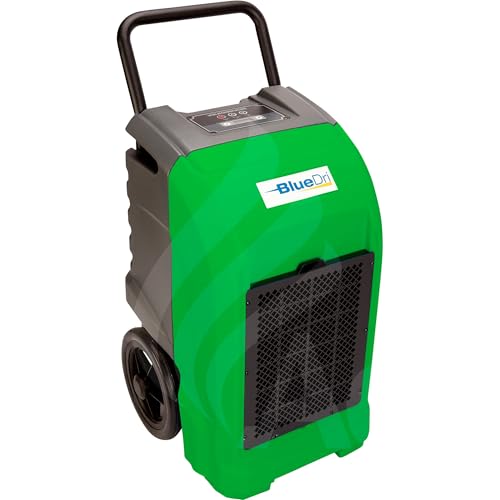
The BD-76P is BlueDri’s long-running commercial workhorse, a conventional refrigerant machine in a roto-molded polyethylene roll-cage style housing with a rigid handle and semi-pneumatic wheels. It removes 76 pints per day at the AHAM condition and 150 pints per day at saturation, figures that place it at the smaller end of this guide while still sitting firmly in commercial territory. Airflow is 235 CFM. BlueDri does not publish a square-foot coverage figure for the model; like the Dri-Eaz above, it is specified by capacity and airflow, and in practice it is sold for large basements, garages and water damage work.
An automatic internal pump handles drainage, with a manual purge button on the panel to empty the pump reservoir before the machine is moved, a small detail that prevents spills on stairs. The manual puts the working drain line height at up to 15 ft. The digital panel includes an hour counter alongside the humidistat, which helps track drying time on a flooded basement, and the unit stacks two high for storage. The housing warranty coverage reflects the design intent: the shell is the part expected to take the knocks. For buyers who want a proven, simple restoration machine without connected features, the BD-76P is the straightforward option here.
Specs
- Water removal: 76 pints per day at AHAM (80°F, 60% RH); 150 pints per day at saturation (90°F, 90% RH)
- Coverage: no square-foot figure published by the maker; sized by capacity and 235 CFM airflow
- Drainage: automatic internal pump with drain hose; drain line height up to 15 ft
- Dimensions: 19 x 20 x 32 in (D x W x H)
- Weight: 81 lbs; operating range 33°F to 100°F
See it on Amazon: https://www.amazon.com/dp/B00I51W3FQ
5. ALORAIR Sentinel HD90

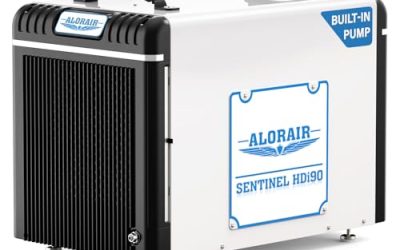
The Sentinel HD90 is the fixed-installation pick of the group: a low, wide cabinet, 23.2 x 15.2 x 17.7 inches, designed to sit permanently in a basement or crawl space and hold the humidity at a set point all year rather than dry out one flood event. It removes 90 pints per day at the AHAM condition and up to 198 pints per day at saturation, and the maker sizes it for areas up to 2,600 sq ft. An onboard humidistat cycles the machine automatically, automatic defrost keeps it working in cool air, and memory restart restores operation after an outage without anyone going downstairs.
Drainage is by a continuous gravity drain hose connection rather than a pump, so this model suits basements with a floor drain, a sump pit or a condensate line below the unit’s position; where water has to be lifted, one of the pump models above is the better fit. Adjustable leveling feet keep the cabinet draining correctly on uneven slabs, and the coils carry internal corrosion protection, which matters in a machine expected to live in damp air for years. At 70.5 lbs it is a two-person lift into place, but once installed it is the most set-and-forget option in this guide for a large basement with a persistent damp problem rather than a one-off flood.
Specs
- Water removal: 90 pints per day at AHAM (80°F, 60% RH); 198 pints per day at saturation
- Coverage: up to 2,600 sq ft
- Drainage: continuous gravity drain hose connection (no built-in pump on this model)
- Dimensions: 23.2 x 15.2 x 17.7 in
- Weight: 70.5 lbs; auto defrost and memory restart
See it on Amazon: https://www.amazon.com/dp/B0F1N43CG5
Choosing between them
For drying a large basement after a flood or a major leak, the Dri-Eaz LGR 6000Li and the ALORAIR Storm LGR Extreme are the restoration picks: both pair high AHAM capacity with a built-in pump and a long hose, and the Dri-Eaz adds the strongest airflow here for very large open floors. For the widest listed coverage in a single rolling unit, the Waykar covers up to 8,000 sq ft on the maker’s figures, with the caveat that its capacity is quoted at a hotter, wetter condition than AHAM. The BlueDri BD-76P is the simple, rugged middle option for repeated wet-basement work. The Sentinel HD90 is the one to leave in place permanently where a gravity drain exists and the problem is chronic damp rather than a single event. Whichever model is chosen, plan the drain route before ordering: pump lift and hose length decide where the machine can sit, and placement decides how well the whole basement dries.
FAQ
How many pints per day does a large basement actually need?
For ongoing damp control in a large basement, look at the AHAM figure first, since it reflects realistic basement air. A unit in the 70 to 100 pint AHAM range, like the BlueDri, the Storm LGR Extreme, the Sentinel HD90 or the Dri-Eaz in this guide, is the commercial class sized for big spaces. After standing water, the saturation figure and airflow matter more, because the first days of drying happen in near-saturated air. Undersizing is the common mistake: a household machine may run constantly and still lose ground in a large, wet basement.
Is a built-in pump necessary, or is a gravity drain hose enough?
It depends on where the water can go. If the basement has a floor drain, sump pit or utility sink below the unit, a gravity hose, as fitted to the Sentinel HD90, drains continuously with no moving parts. If the only drain is a raised sink, a washing machine standpipe or a line that exits above floor level, a pump is required: the Waykar lifts water up to 16.4 ft, the Storm LGR Extreme up to 14.7 ft, and the Dri-Eaz and BlueDri pumps push water through long hoses to a discharge point. Measure the lift and distance before choosing.
Why do the pint figures differ so much between brands?
Because the test conditions differ. AHAM figures are measured at 80°F and 60 percent humidity and are the lowest, most realistic numbers. Saturation figures are measured at 90°F and 90 percent humidity and can be double the AHAM number for the same machine. Some brands quote a headline figure at 95°F and 90 percent humidity, which sits outside both. The specs in this guide always name the condition next to the figure, and comparing AHAM to AHAM is the fair way to line these units up against each other.
Can one commercial dehumidifier handle a whole large basement?
In an open-plan basement, generally yes, provided the unit’s listed coverage meets or exceeds the floor area and the air can circulate freely. Finished basements divided into separate rooms are harder: closed doors block the airflow the machine depends on, so a single unit may dry the room it sits in while distant rooms stay damp. In that layout, makers’ coverage figures assume open air movement; propping doors open, adding air movers, or placing a second smaller commercial unit in the far section are the usual answers. Ductable models exist for split layouts, but they fall outside the portable units covered here.