Key takeaways
- Compare ducted basement dehumidifiers for humid storage rooms by pint capacity, coverage, ducting, drainage, humidistat control and low-temperature use.
A basement storage room is one of the hardest places in a house to keep dry. It is usually below grade, poorly ventilated, and filled with the things humidity damages first: cardboard boxes, documents, photographs, clothing, wooden furniture, tools, and seasonal equipment. A portable room dehumidifier can help in a single open space, but it struggles when the basement is divided into rooms, when the dampest corner is far from the unit, or when you do not want a bulky appliance sitting in the middle of your storage area. That is exactly the problem a ducted basement dehumidifier is built to solve.
A ducted unit sits in one location — often a utility area, an unfinished corner, or a spot near a drain — and moves air through ductwork. A return duct can pull humid air from the storage room itself, and a supply duct can deliver dried air back into that room or into more than one divided area. The unit stays out of the way, the storage room gets targeted treatment, and there is no bucket to empty because these machines drain continuously.
As an Amazon Associate we earn from qualifying purchases.
This guide explains how to choose a ducted model for a humid storage room, what the capacity and coverage figures actually mean, and how the ducting, drainage, and control options differ. It then looks at four ducted or ductable models from AprilAire and ALORAIR that are sold for basement, crawl space, and whole-home use, and closes with installation notes and answers to common questions.
Why Ducting Matters for a Storage Room
In an open basement, air mixes freely, so a freestanding unit can gradually work on the whole volume. A storage room changes that picture. A closed door, a partition wall, or a long L-shaped layout can leave a pocket of still, damp air that a distant dehumidifier barely touches. Boxes stacked against an exterior wall make the problem worse, because air cannot circulate behind them and the wall surface is often the coldest, most condensation-prone surface in the room.
Ducting addresses both issues. With a ducted installation, the intake can be positioned to draw air from the humid room rather than from wherever the unit happens to sit, and the discharge can be directed into the room so dry air actually reaches the stored items. For basements split into several spaces, duct connections can also let one larger unit serve divided areas instead of requiring a separate portable machine in each room. The trade-off is planning: duct runs, collars, and drainage need to be thought through before the unit is placed, and the installation takes more effort than simply plugging in a portable model.
How to Choose a Ducted Basement Dehumidifier
Pint capacity: read both numbers
Capacity is stated in pints of water removed per day, but manufacturers often quote two figures. The AHAM figure is measured at a standard test condition and is the more conservative, more comparable number. The saturation figure is measured in hotter, much wetter air and is always larger. A unit described as removing 198 pints at saturation and 90 pints at AHAM is, for everyday comparison purposes, a 90-pint class machine. Always compare models using the same basis, and be suspicious of any listing that only advertises the saturation number.
Coverage area
Ducting options
Check how the unit connects to ductwork. Some models include inlet and outlet duct collars in the box, which simplifies installation. The AprilAire E070 listing, for example, includes 8-inch outlet and inlet duct collars, and the AprilAire E100 bundle listings include 10-inch outlet and inlet duct collars. ALORAIR describes ducting options and optional duct mounting for its Sentinel HDi90, with a duct-able version offered for divided spaces. Confirm the collar size, whether collars are included or sold separately, and whether the duct plan is a simple single-room loop or a longer run serving multiple areas, because longer and more complex runs place more demand on the unit’s airflow.
Drainage and pumps
Every model in this category drains continuously; none relies on a bucket you carry to a sink. The differences are in how the water leaves. Gravity drainage is simple and reliable when a floor drain or sump sits below the unit. A condensate pump matters when the drain is above the unit, across the room, or when the unit sits in a low spot with no nearby drain. The AprilAire E100 bundle described below includes a condensate pump, and the ALORAIR Sentinel HDi90 is a pump-equipped model. If your only drain is a laundry sink or a drain line at ceiling height, a pump is not an optional extra — it is a requirement.
Humidistat control
Look for built-in humidistat control that lets you set a target relative humidity and lets the unit cycle on and off to hold it. For stored goods, a steady moderate setting is the goal: dry enough to discourage mold growth on boxes, paper, and fabric, without wasting energy over-drying the space. Remote or wall-mounted control options are worth considering when the unit will be ducted into a closed utility area or hung out of easy reach, because they let you check and adjust the setting from a convenient location. Some models also offer app or Wi-Fi variants, but the core requirement is accurate, automatic humidity sensing.
Operating temperature and defrost
Basements are cool, and storage rooms in northern climates can be cold for much of the year. Refrigerant dehumidifiers lose effectiveness as temperatures fall, and coils can frost. Look for automatic defrost and a stated functioning temperature range suited to cool spaces. The ALORAIR Sentinel HDi90 specification lists a functioning temperature range beginning at 33.8 degrees Fahrenheit, with defrosting control, which illustrates the kind of low-temperature design to look for in this category. AprilAire positions its E070 and E100 models for sealed crawl spaces and basements, which are similarly cool environments. Whatever model you choose, confirm its low-temperature behaviour matches the coldest conditions your basement actually reaches.
The Ducted Models in This Guide
AprilAire E100 Pro Dehumidifier Bundle

The AprilAire E100 Pro bundle is the largest-capacity option in this guide. The listing describes a 100-pint whole-house dehumidifier for crawl spaces, basements, whole homes, and commercial use in areas up to 5,500 square feet. For a big basement where one ducted unit is expected to handle a storage room plus the surrounding below-grade space, that coverage headroom is the main reason to consider this model.
Ducting is central to the bundle. The listing’s included components include inlet and outlet duct collars, along with a drain hose and filter, so the parts needed for a ducted installation are part of the kit rather than separate purchases. A related E100 kit listing describes 10-inch outlet and inlet duct collars, a backdraft damper, leveling feet, a barbed drain fitting, and a washable MERV 8 filter among its components.
AprilAire E070 Pro Dehumidifier with Model 76 Wall Mount Control

The AprilAire E070 Pro listing pairs the 70-pint E070 dehumidifier with the Model 76 wall mount control. The listing states that the E070 removes up to 70 pints of moisture per day from spaces up to 2,200 square feet, and describes it as ideal for dehumidifying a sealed crawl space — the same kind of enclosed, cool, below-grade environment as a basement storage room.
The ducting provision is explicit in the listing. Included components include an 8-inch outlet duct collar and an 8-inch inlet duct collar, together with leveling feet, a barbed drain fitting, an 8-foot power cord, 10-foot drain tubing, and a washable MERV 8 filter. That means a return duct can draw humid air from the storage room and a supply duct can return dried air to it, with the collars needed for those connections supplied in the box.
Drainage is continuous through the included drain tubing, with no water tray to empty. The wall mount control is this bundle’s distinguishing feature: it lets you set and check humidity from a convenient spot even when the unit is ducted into a utility area. Choose the E070 if your area falls within its stated coverage and you want included collars plus a remote wall control.
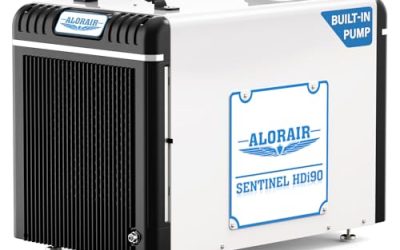
ALORAIR Sentinel HDi90 Crawl Space and Basement Dehumidifier with Pump

The ALORAIR Sentinel HDi90 is a commercial-grade crawl space and basement dehumidifier built around a condensate pump. Its ratings illustrate why both capacity figures matter: the manufacturer lists 90 pints per day at AHAM conditions and 198 pints per day at saturation, for areas up to 2,600 square feet. Compared on the AHAM basis, it sits between the E070 and the E100 in this guide.
Ducting is a documented part of this model’s design. The manufacturer’s specification lists ducting options among its features, describes optional duct mounting flanges that reduce installation time when connecting to new or existing ducting, and notes ducting options for divided spaces. A duct-able version of the HDi90 is offered specifically for installations where the unit sits apart from the area being dried, which is a common storage room layout: the machine in the utility area, the ducts serving the storage room.
The specification also lists automatic humidistat control, hot gas defrosting, airflow of 230 CFM, and a pre-filter with an optional MERV-8 filter. Choose the HDi90 if your drain requires a pump, your basement is cool, and you want ducting options for a divided layout.
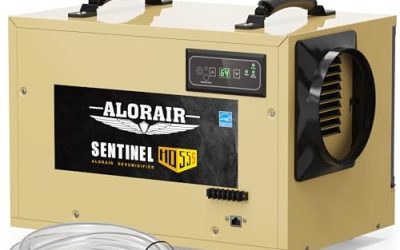
ALORAIR Sentinel HD55 Commercial Dehumidifier

The ALORAIR Sentinel HD55 is the smallest model in this guide, and the appropriate starting point for a modest storage room rather than a whole large basement. The Amazon listing describes a commercial dehumidifier that removes 113 pints per day at saturation and 53 pints per day at AHAM conditions, for areas up to 1,200 square feet. On the comparable AHAM figure, it is a compact unit for a single storage room and its immediate surroundings.
The listing describes the HD55 as a crawl space and basement unit with a drain hose for continuous gravity drainage, automatic defrost, and memory starting, which restarts the unit with its previous settings after a power cut. ALORAIR describes optional HVAC duct connections for this Sentinel class of unit, allowing supply and return duct applications so the unit can condition an adjacent area rather than only the space it sits in. Confirm the specific duct accessories for the exact listing variant before ordering, because duct kits and collars in this product family can be optional extras rather than included parts.
The HD55 drains by gravity, so it needs a floor drain, sump, or other low discharge point nearby. If your storage room has no suitable low drain and water must be lifted, a pump-equipped model such as the HDi90 above is the better fit. The listing also notes optional remote control compatibility, which can help when the unit is installed in a hard-to-reach spot.
Choose the HD55 if your humid storage area is relatively small, a gravity drain is available, and you want a compact commercial-grade ductable unit rather than the capacity — and physical size — of the larger models.
Which One Should You Pick?
Start with area and dampness, then let drainage make the final decision.
For a small storage room or a compact basement up to the HD55’s stated coverage, with a floor drain nearby, the ALORAIR Sentinel HD55 covers the job in the smallest package here. Its gravity drainage is its main constraint, so the drain has to work with the layout.
For a mid-sized basement up to the E070’s stated coverage, the AprilAire E070 Pro bundle with the Model 76 control is the balanced choice. The included 8-inch inlet and outlet collars simplify the duct work, and the wall-mounted control is genuinely useful once the unit is installed out of the way.
For a cool basement where water must be pumped to reach a drain, the ALORAIR Sentinel HDi90 is the natural pick. Its pump, low stated minimum operating temperature, defrost system, and ducting options for divided spaces address the three problems that most often defeat basement installations: drainage, cold, and layout.
For a large or very humid basement, or one ducted system expected to serve a storage room plus substantial additional space up to the E100 bundle’s stated coverage, the AprilAire E100 Pro bundle offers the most capacity headroom and includes collars and a drain hose in the kit.
Installation Notes for a Ducted Storage Room Setup
Plan the air path first. Decide where humid air will be drawn from and where dry air will be delivered, keeping the return and supply far enough apart that dried air does not short-circuit straight back into the intake. In a storage room, delivering dry air toward the most condensation-prone exterior wall, while drawing return air from the room’s interior, generally serves the stored items better than placing both openings side by side.
Finally, address the moisture source. A dehumidifier manages humidity; it does not fix active water intrusion. Gutters, grading, plumbing leaks, and unsealed openings should be dealt with separately, or even a correctly sized ducted unit will run constantly against a problem it was not designed to solve. Leave clearance around stored boxes so air can circulate, and avoid pressing cardboard directly against cold exterior walls.
Frequently Asked Questions
Why choose a ducted dehumidifier instead of a portable one for storage?
Because the storage room is usually not where the unit can conveniently sit, and its air does not mix freely with the rest of the basement. Ducting lets the unit draw humid air from the storage room and return dry air to it, while the machine itself stays in a utility area near a drain. Ducted models also drain continuously, so there is no bucket to empty in a room you may not check often.
What humidity level should a storage room be kept at?
A moderate, steady setting that discourages mold growth on paper, fabric, wood, and cardboard is the goal. The exact target depends on what is stored and on the basement’s temperature, but consistency matters more than chasing the lowest possible number. Use the unit’s humidistat to hold a chosen setting automatically rather than running the machine continuously without control.
How do I compare pint ratings between brands?
Compare the AHAM figures, which are measured at a standard condition. Saturation figures are measured in much hotter, wetter air and are always higher. A unit listed at 198 pints at saturation and 90 pints at AHAM should be compared with other models as a 90-pint class machine.
Do I need a condensate pump?
Only if gravity drainage cannot work. If a floor drain or sump sits below the unit, gravity drainage is simple and has fewer parts. If the drain is above the unit, far away, or at sink height, a pump is necessary. Among the models here, the Sentinel HDi90 is pump-equipped, and an E100 kit variant includes a condensate pump, while the HD55 relies on gravity drainage.
Can one ducted unit serve more than one basement room?
Yes, that is one of the main reasons to choose this category. Ducting options for divided spaces allow a suitably sized unit to draw from and supply more than one area. The key limits are total area, total dampness, and duct layout — a unit sized for one small room will not dry a whole divided basement just because ducts are attached.
Will a ducted dehumidifier work in a cold basement?
Models in this category are designed for cool below-grade spaces, with automatic defrost to handle coil frosting. Check the stated functioning temperature range for the specific model — the HDi90 specification, for example, begins at 33.8 degrees Fahrenheit — and match it to the coldest conditions your basement reaches. Capacity falls as temperatures drop, so a cold, damp basement argues for sizing up.
How much maintenance does a ducted unit need?
Mainly filter care and drain checks. Wash or replace the filter on the schedule the manufacturer states, confirm the drain line or pump is flowing freely, and check the humidity reading periodically — which is easier with a wall-mounted or remote control. There is no bucket to empty, but a blocked drain line can stop an otherwise healthy unit from doing its job.