Key takeaways
- Looking for the best compact crawl space dehumidifiers? Compare three low-profile picks with built-in pumps, hose drainage, and published coverage figures.
A crawl space is one of the hardest places in a house to dry out. Clearance is low, access is awkward, and once moisture settles in, it can feed mold on joists, musty air that rises into the living space, and slow damage to anything stored or built above it. A compact dehumidifier built for that environment solves a specific problem: it has to fit through a small access opening, sit in limited headroom, and move water out of the space without anyone crawling in to empty a bucket every few days. The three picks below were selected from published listing specifications rather than detailed research, and each one approaches the job differently — two are purpose-built crawl space units with built-in pumps, and one is a compact residential dehumidifier whose listing explicitly publishes crawl-space use.
As an Amazon Associate, we earn from qualifying purchases.
Quick answer
If your crawl space has no floor drain and water needs to travel up and out, start with the BaseAire Crawlspace Dehumidifier with Pump (70 PPD): it pairs a compact 15.35 × 11.2 × 11.4-inch footprint with a built-in pump and coverage up to 1,000 sq ft. For a larger crawl space, the Tiitss 120 Pint (120DW) is the high-capacity option, rated up to 5,500 sq ft with a built-in pump and a 16.4 ft hose. If your space is smaller, drier, and has a drain line a hose can reach by gravity, the AEOCKY ARION-001 is a compact residential unit whose product page explicitly lists crawl-space use, with a small tank and hose drainage instead of a pump.
Key takeaways
- Drainage matters more than raw capacity in a crawl space: a built-in pump lets water leave uphill, while gravity drainage only works when a drain sits below the unit.
- Published pint ratings use different test conditions, so compare the AHAM figure when one is given — the Tiitss, for example, publishes 120 pt/day maximum and 53 pt/day AHAM.
- Compact dimensions decide what actually fits through your access hatch and under your joists; two of these three picks publish exact measurements you can check before ordering.
- Coverage ratings assume a sealed, conditioned-style space — a vented crawl space with exposed earth will work any unit harder than its headline figure suggests.
The picks
1. BaseAire Crawlspace Dehumidifier with Pump, 70 PPD
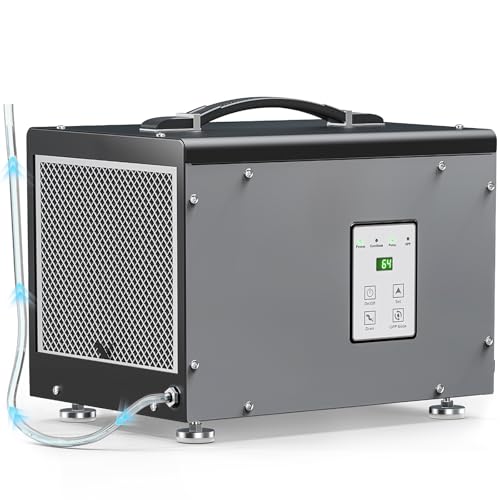
The BaseAire is the most purpose-built of the three for tight spaces. Its published dimensions — 15.35 × 11.2 × 11.4 inches — make it a genuinely low-profile unit, the kind of footprint that slides through a standard crawl space access door and sits under floor joists without eating the clearance you need to move around it. It is rated in the 70 pints-per-day class and covers up to 1,000 sq ft, which suits the smaller-to-midsize crawl spaces found under most single-story homes and additions.
The built-in pump is the deciding feature here: instead of relying on a nearby floor drain, the unit can push condensate up and out to a sink, a sump, or an exterior line. BaseAire also publishes GLGR technology and auto defrost, the latter being genuinely useful in crawl spaces that run cool, where frost on the coils can stall a lesser unit. For a damp, low crawl space with no drain, this is the most complete fit on the list.
Specs
- Capacity class: 70 pints/day
- Dimensions: 15.35 × 11.2 × 11.4 inches
- Coverage: up to 1,000 sq ft
- Drainage: built-in pump
- Features: GLGR technology, auto defrost
2. Tiitss 120 Pint Crawl Space Dehumidifier (120DW)

The Tiitss 120DW is the capacity pick, aimed at large crawl spaces and whole-basement-style moisture loads. Its listing publishes a maximum removal rate of 120 pints per day, with a 53-pint AHAM figure alongside it — that second number is the more conservative, standardized rating, and it is still substantial. Airflow is published at 230 CFM, and coverage runs up to 5,500 sq ft, well beyond what most residential crawl spaces need, which means the unit can cycle less aggressively in a midsize space rather than running flat-out.
Drainage is handled by a built-in pump paired with a 16.4 ft hose, giving you real flexibility on where the water exits — useful in long crawl spaces where the access point and the sensible drain location are far apart. One caution: the listing’s dimension figures conflict between its bullet points and its specification table, so we are not citing dimensions for this model here. Measure your access opening and headroom, then confirm the current figures on the product page before ordering.
Specs
- Capacity: 120 pt/day maximum; 53 pt/day AHAM
- Airflow: 230 CFM
- Coverage: up to 5,500 sq ft
- Drainage: built-in pump with 16.4 ft hose
3. AEOCKY ARION-001

The AEOCKY ARION-001 is the honest budget-format option on this list, and it deserves an honest description: this is a compact residential dehumidifier, not a commercial crawl-space machine. What earns it a place here is that its product page explicitly publishes crawl-space use among its applications, and its published dimensions — 8.03 × 11.1 × 15.75 inches — make it easy to position in a low space. It is rated at 50 pt/day with coverage up to 3,000 sq ft.
The trade-off is drainage. There is no pump: you get a 0.5-gallon tank, which will fill quickly in a genuinely wet crawl space, plus hose drainage that depends entirely on gravity. That makes the AEOCKY a sensible pick only where a drain line sits lower than the unit and moisture levels are moderate — a mostly dry crawl space you want to keep that way, rather than a wet one you need to rescue. In the right setting, its compact size and straightforward design are exactly what is needed; in a flooded or drain-free space, choose one of the pump models above instead.
Specs
- Capacity: 50 pt/day
- Coverage: up to 3,000 sq ft
- Dimensions: 8.03 × 11.1 × 15.75 inches
- Drainage: 0.5-gallon tank plus hose (gravity); no pump
- Published use: crawl spaces listed on the product page
How to choose
Start with drainage, because it rules out more models than capacity does. Crawl under the house (or send a camera) and find your water exit: a floor drain, a sump pit, or a line you can run outside. If that exit is level with or below where the dehumidifier will sit, gravity drainage through a hose works. If water has to rise at all — up to a sink, over a foundation wall, out through a vent — you need a built-in pump, which is what the BaseAire and Tiitss provide. The AEOCKY’s small tank is a maintenance trap in a wet space: a 0.5-gallon tank in a crawl space producing pints of water a day means daily trips through the hatch.
Next, measure the space, not just the floor area. Check the access opening’s width and height, then the headroom at the spot where the unit will live. Compare those numbers against published dimensions — the BaseAire at 11.4 inches tall and the AEOCKY at 15.75 inches tall fit very different joists bays. For the Tiitss, whose listing publishes conflicting dimension figures, verify the current numbers on the page before relying on them.
Then match capacity to the real moisture load. Published pint ratings are measured under warm, humid test conditions; the AHAM figure, when a listing provides one, reflects a more moderate standard and is the safer planning number. A sealed crawl space with a vapor barrier needs far less removal capacity than a vented one with exposed earth. Coverage figures — 1,000, 3,000, and 5,500 sq ft across these three picks — are best treated as relative tiers rather than guarantees. Finally, think about the conditions the unit will live in: crawl spaces run cool, so a model that publishes auto defrost, like the BaseAire, is better suited to shoulder-season operation than one with no stated frost handling.
Who should skip
Skip compact crawl space dehumidifiers entirely if your moisture problem is liquid water — standing puddles, active leaks, or groundwater intrusion need drainage correction, a sump, or waterproofing first; a dehumidifier manages humidity, not flooding. Skip the pump models if your crawl space has a convenient low drain and mild humidity, because you would be paying for hardware you never use — the gravity-fed AEOCKY covers that case. Skip the AEOCKY, conversely, if your space is large, very wet, or lacks any drain below unit level; without a pump, it cannot move water uphill, and its small tank will not keep up. And skip all three if your “crawl space” is really a full-height basement room you use daily — a standard residential unit with a larger tank will be easier to live with and empty.
FAQ
Do I really need a built-in pump for a crawl space dehumidifier?
Only if the water has nowhere downhill to go. A pump matters when the drain, sump, or exit point sits higher than the dehumidifier or far from it — a common crawl space layout. If a floor drain sits below the unit, a gravity hose does the same job with fewer moving parts, which is the setup the AEOCKY is built around.
How do pint ratings work, and why does the Tiitss list two numbers?
Pint ratings describe how much water a unit removes in 24 hours under specified test conditions, and warmer, wetter test air produces bigger numbers. The Tiitss publishes 120 pt/day as its maximum and 53 pt/day under the AHAM standard, which uses cooler, less humid conditions closer to a real crawl space. When a listing gives both, plan around the AHAM figure.
Can a regular compact dehumidifier work in a crawl space?
Sometimes, with limits. The AEOCKY ARION-001 is a residential unit whose page explicitly publishes crawl-space use, so it is a legitimate option for moderate moisture with gravity drainage. What a residential unit generally lacks is a pump and crawl-space-specific design, so it suits prevention in a mostly dry space better than recovery in a wet one.
What humidity level should a crawl space dehumidifier maintain?
A common target range is roughly 30 to 50 percent relative humidity — dry enough to discourage mold growth on wood framing, without over-drying. Set the unit’s humidistat in that band, give it a few days to pull the space down, and check with an inexpensive remote hygrometer rather than repeated trips under the house.
Final verdict
For most crawl spaces, the BaseAire is the balanced pick: genuinely compact published dimensions, a built-in pump, auto defrost for cool conditions, and coverage sized to a typical home. The Tiitss 120DW is the step up for large or very damp spaces, with the highest published removal capacity and coverage here — just verify its dimensions on the listing before ordering, since the page’s figures conflict. The AEOCKY ARION-001 earns its place as the compact, gravity-drain option for smaller, moderately damp crawl spaces, provided you understand it is a residential unit with a small tank and no pump. Choose by drainage first, fit second, and capacity third, and any of the three will do its job.
Product and ASIN Reference
| Product | ASIN |
|---|---|
| Tiitss 120 Pint Crawl Space Dehumidifier (120DW) | B0DFLTCFW9 |
| BaseAire Crawlspace Dehumidifier with Pump, 70 PPD | B0DQY78BY6 |
| AEOCKY ARION-001 | B0HF7SBZPN |