Key takeaways
- Compare ducted basement dehumidifiers built for cold spaces, with low-temperature ratings, duct collar sizes, drainage options and capacities compared.
A cold basement defeats most portable dehumidifiers twice over: the coil frosts as temperatures fall, and a single unit sitting in one corner never reaches the damp air trapped in distant rooms. Ducting changes that equation, because the machine can pull moist air from one end of the basement and push dried air somewhere else entirely. The real decision is therefore about operating temperature first and duct layout second, with headline pint capacity only third.
This guide suits homeowners with unheated or partly heated basements, people finishing a lower level who want the unit hidden in a utility area, and anyone whose basement connects to existing ductwork. Every pick below is a ductable commercial or whole-home unit chosen from its Amazon listing details, including its stated temperature range and collar sizes.
Quick Picks
As an Amazon Associate we earn from qualifying purchases
| Product | Best for | Key spec from title |
|---|---|---|
| ALORAIR Sentinel HD55S | Coldest basements with a floor drain nearby | 55 pints per day at AHAM |
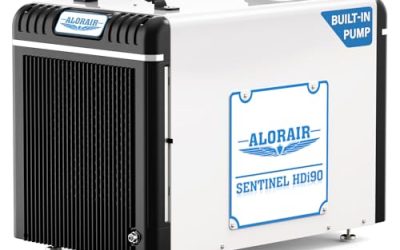
| ALORAIR Sentinel HDi90 Duct | Larger damp basements with no drain at floor level | 90 pints per day at AHAM |
| AprilAire E070 Pro | Low ceilings and quiet ducted runs under living space | 70 pints per day |
| AprilAire E080 Pro | Big basements tied into existing ductwork | 80 pints per day |
How to Choose
Start with the lowest temperature, not the pint rating
Capacity figures are measured in warm test air, yet a basement that sits at 45 degrees in January asks a very different question. Check the bottom of the stated operating range before anything else. The AlorAir units in this guide list functioning temperatures down to 33.8 degrees Fahrenheit, supported by automatic defrosting. The AprilAire models list dehumidification inlet conditions starting at 50 degrees Fahrenheit, which suits a basement that stays cool rather than near freezing. Match the machine to the coldest week your basement actually sees, not to the mild afternoon when you happened to check it.
Confirm the ducting hardware is real, not implied
Ducted should mean collars, diameters and a discharge path you can plan around, so read the listing for those specifics. The AprilAire E070 ships with 8-inch inlet and outlet duct collars, while the E080 steps up to 10-inch collars and adds a backdraft damper at the outlet. AlorAir describes the HDi90 as connectable to ductwork for distributing dried air across a larger area, and lists ducting options among the HD55S design features. If a listing never names a collar size or duct connection, treat the ducted claim as unproven and look elsewhere.
Plan drainage before the unit arrives
None of these machines uses a bucket you carry upstairs, which is the point, but the water still needs somewhere to go. The HD55S drains by gravity, so it wants a floor drain, sump or waste line lower than the unit. The HDi90 carries a heavy-duty built-in condensate pump, which pushes water out when the drain sits higher or farther away. AprilAire supplies a barbed drain fitting and threaded connection on its units. Sketch the drain route, its slope and its distance before ordering, because drainage, not capacity, is what most often stalls an installation.
Size by coverage and airflow together
Pints per day describe how much water a unit can pull, while airflow describes how far its effect reaches through ductwork. A long duct run with several bends loses airflow to static pressure, and AprilAire publishes that drop directly: the E070 moves 200 CFM at zero static pressure but 140 CFM at 0.4 inches. Compare the stated coverage area against your basement footprint, then check whether the airflow figure still looks adequate once your duct layout adds resistance. Oversizing slightly for a ducted layout is safer than assuming free-air numbers survive the run.
The 4 Best Options
ALORAIR Sentinel HD55S

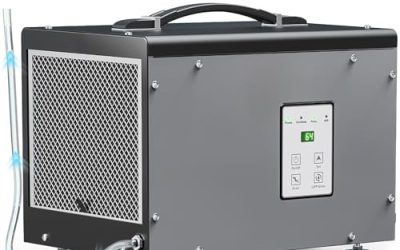
Cold is where this compact commercial unit earns its place. Its listing gives a functioning temperature range starting at 33.8 degrees Fahrenheit, paired with an auto defrosting system, so it keeps working in an unheated basement long after a household unit would ice over and pause. The rated removal is 55 pints per day at AHAM conditions for spaces up to 1,300 square feet, and ducting options let it sit in a utility corner while serving a finished room nearby. A metal housing, cETL listing and gravity drainage suit a set-and-forget installation beside a floor drain.
Specs
- Capacity: 120 pints per day at saturation, 55 pints per day at AHAM
- Coverage: up to 1,300 sq. ft.
- Airflow: 130 CFM
- Functioning temperature range: 33.8 to 104 degrees Fahrenheit
- Functioning humidity range: 35 to 90 percent
- Draining: gravity draining
- Filter: MERV-8 filter
- Sound pressure level: under 52 dB(A)
- Ducting options listed among its design features
Best for: Unheated basements that drop into the thirties and forties, with a floor drain within gravity reach.
Watch out for: There is no built-in pump, so a drain that sits above the unit means adding a separate condensate pump.
ASIN: B094C9H51K
ALORAIR Sentinel HDi90 Duct

When the basement is large, persistently wet and short on drainage options, the HDi90 brings both capacity and a pump. The listing rates it at 90 pints per day under AHAM conditions and up to 2,600 square feet of coverage, and it can be connected to ductwork to distribute dehumidified air throughout a bigger area instead of drying one corner. Its heavy-duty condensate pump removes collected water continuously, which frees placement from the nearest floor drain. The stated operating range again starts at 33.8 degrees Fahrenheit, and the cabinet is metal with a rare earth alloy tube evaporator.
Specs
- Capacity: 198 pints per day at saturation, 90 pints per day at AHAM
- Coverage: up to 2,600 sq. ft.
- Airflow: 210 CFM
- Operating temperature: 33.8 to 104 degrees Fahrenheit
- Operating humidity: 36 to 90 percent
- Drainage: heavy-duty built-in condensate pump
- Filter: MERV-1
- Noise level: 58 dBA
- Housing: metal, with carry handles
Best for: Large, very damp basements where the drain is uphill, distant or simply not at floor level.
Watch out for: At roughly 18 inches tall it needs more clearance than the compact crawl-space cabinets, so measure the install space first.
ASIN: B07YSN7V1T
AprilAire E070 Pro
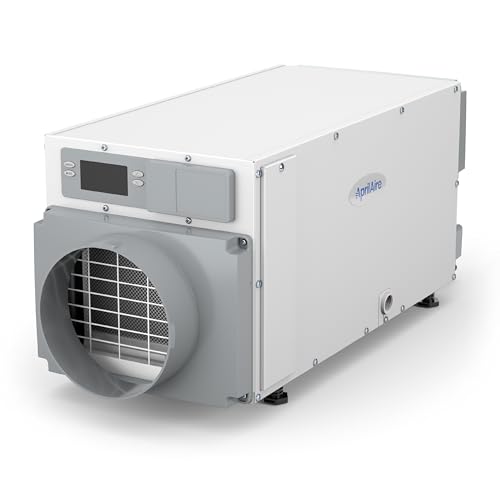
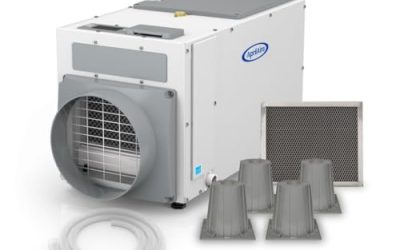
The E070 is the low-profile ducted option, built around a cabinet only 12.5 inches tall that slides into tight mechanical spaces and under-floor areas. It removes up to 70 pints of moisture per day for spaces up to 2,200 square feet, and both 8-inch duct collars are included in the box, alongside leveling feet, a barbed drain fitting and drain tubing. A built-in digital control manages operation, and the listing notes corrosion-resistant aluminum coils. Its published ducted noise figure and modest footprint make it a sensible pick where the unit lives directly beneath occupied rooms.
Specs
- Capacity: 70 pints per day at 80 degrees Fahrenheit and 60 percent RH; 53 pints per day at 73 degrees Fahrenheit
- Coverage: up to 2,200 sq. ft.
- Airflow: 200 CFM at 0.0 in. w.c., 140 CFM at 0.4 in. w.c.
- Duct collars: 8-inch inlet and 8-inch outlet, included
- Dehumidification inlet conditions: 50 to 104 degrees Fahrenheit, 40 degree dew point minimum
- Filter: washable MERV 8
- Noise: 53 dBA ducted
- Dimensions: 12.5 x 12.5 x 25 inches; weight 56 lbs
Best for: Low-clearance basements and ducted runs passing under bedrooms or living rooms.
Watch out for: Dehumidification is rated from 50 degrees Fahrenheit upward, so a basement that regularly falls below that needs a colder-rated unit instead.
ASIN: B094PR3HQ1
AprilAire E080 Pro

For a bigger basement that already has ductwork worth using, the E080 scales everything up a step. It removes up to 80 pints of water per day across spaces up to 4,400 square feet, connects through 10-inch inlet and outlet duct collars, and includes a backdraft damper at the outlet. The listing describes it as ENERGY STAR certified and commercial-grade, with a washable MERV 8 filter and corrosion-resistant aluminum coils. Air can discharge from the top or the end of the cabinet, which gives an installer useful flexibility when the duct trunk sits in an awkward spot relative to the unit.
Specs
- Capacity: 80 pints per day at 80 degrees Fahrenheit and 60 percent RH; 65 pints per day at 73 degrees Fahrenheit
- Coverage: up to 4,400 sq. ft.
- Airflow: 185 CFM at 0.0 in. w.c., 85 CFM at 0.4 in. w.c.
- Duct collars: 10-inch inlet and 10-inch outlet, with backdraft damper
- Dehumidification inlet conditions: 50 to 104 degrees Fahrenheit, 40 degree dew point minimum
- Filter: washable MERV 8
- Noise: 45 dBA ducted
- Dimensions: 14 x 15 x 26 inches; weight 63 lbs
Best for: Larger basements and whole-home layouts tying into an existing duct system.
Watch out for: Airflow falls sharply as static pressure rises, so long or restrictive duct runs should be planned with an installer.
ASIN: B094PWS7K2
Which One Fits Your Situation
Your basement drops below 50 degrees in winter
Choose one of the AlorAir units, because both list operation down to 33.8 degrees Fahrenheit with automatic defrosting. The HD55S covers smaller basements up to 1,300 square feet and drains by gravity, while the HDi90 handles up to 2,600 square feet and pumps its condensate away. The AprilAire models, rated for dehumidification from 50 degrees upward, are better saved for basements that stay cool rather than cold.
The unit must hide in a utility area and dry a finished room
The HD55S and the AprilAire E070 both fit this pattern well, since each can sit away from the space it serves and move air through ducting. The E070 includes its 8-inch collars in the box and stands only 12.5 inches tall, which helps in cramped mechanical corners. Pick between them on temperature: colder utility space points to the AlorAir, a milder one to the AprilAire.
There is no usable floor drain
The HDi90 is the straightforward answer here, because its built-in condensate pump pushes water up and out to a drain that gravity could never reach. Every other unit in this guide relies on a downhill drain path or a threaded drain connection. If your only drain sits across the basement or above the unit’s outlet height, the pump stops being a convenience and becomes the deciding feature.
You are tying into existing HVAC ductwork
The AprilAire E080 was designed with that job in mind, offering 10-inch collars, a backdraft damper and top or end discharge in a cabinet rated for up to 4,400 square feet. Its published airflow figures at several static pressures also make duct design more predictable. Budget for professional installation time, since balancing a dehumidifier against an existing trunk line is less forgiving than a standalone run.
Common Mistakes
- Choosing by the saturation pint figure instead of the AHAM rating, which inflates capacity and leads to undersized installs.
- Ignoring the minimum operating temperature, then discovering the unit defrosts constantly or stops in the coldest months.
- Assuming ducted means duct hardware is included, without checking collar sizes or whether collars come in the box.
- Placing a gravity-drain unit where the drain line runs uphill, leaving condensate with nowhere to go.
- Sealing duct joints poorly, so dried air leaks into a joist bay instead of reaching the damp room it was meant for.
Frequently Asked Questions
Can a ducted dehumidifier dry more than one basement room?
Yes, that is the main reason to duct one. The unit draws moist air through an inlet duct and returns dried air through an outlet duct, so placement and duct layout decide which rooms benefit. Long runs and sharp bends reduce airflow, however, so a divided basement still needs a layout that gives each area a realistic path for air to circulate back.
What temperature is too cold for a basement dehumidifier?
It depends on the model rather than the category. The AlorAir units here list operation down to 33.8 degrees Fahrenheit with auto defrost, while the AprilAire models list dehumidification inlet conditions starting at 50 degrees. Below a unit’s stated range it may pause, frost or remove very little water, so compare that figure against your basement’s coldest recorded temperature.
Do ducted units need a condensate pump?
Only when gravity cannot do the job. A unit beside a floor drain with a downhill hose route drains fine on its own, as the HD55S does. If the drain is higher than the outlet, across the room or into a sink, a pump becomes necessary, which is why the HDi90 builds one in rather than leaving it as an accessory.
How often does the filter need attention?
Check it on the schedule the manual sets and whenever airflow seems weaker than usual. These units use washable or replaceable filters such as the MERV 8 in the AprilAire models and the MERV-1 in the HDi90. A clogged filter raises static pressure, cuts airflow through the duct run and quietly reduces how much moisture the machine can remove each day.